
Views: 0 Author: Site Editor Publish Time: 2026-10-21 Origin: Site


Operating a modern jet engine at 30,000 feet creates an exceptionally hostile environment. Temperatures routinely surpass the physical melting point of the metal components inside the combustion chamber. Advanced thermal management technologies are a matter of critical survival for these engines to function safely and efficiently.
The primary defense mechanism against this extreme heat is known as film cooling. This intricate fluid dynamics process requires hundreds of microscopic, highly precise holes machined directly into the aerodynamic surfaces of the turbine blades. These blades are forged from advanced superalloys like Inconel, Rene alloys, and single-crystal titanium. Engineers design these materials specifically to resist heat and deformation. Trying to pierce these hardened materials with traditional twist drills creates an engineering nightmare. Operators face constant tool breakage, severe surface damage, and unacceptable scrap rates.
The aerospace industry relies on Electrical Discharge Machining as the definitive solution to this manufacturing bottleneck. By utilizing thermal-electrical erosion rather than physical friction, this technology offers unmatched precision. It completely eliminates mechanical tool wear and executes flawless micro-holes on complex curved surfaces.
Zero Physical Contact: The spark erosion process completely eliminates the physical friction and torsional stress that cause micro-drill bit breakage.
Hardness Independence: This technology machines aerospace superalloys of any hardness without sacrificing cutting speed or dimensional accuracy.
Extreme Aspect Ratios: Operators achieve incredible depth-to-diameter aspect ratios, producing perfectly straight cooling holes at steep angles without tool deflection.
Cost Efficiency: Transitioning from mechanical drilling to spark erosion significantly reduces expensive scrap rates and eliminates the continuous cost of replacing worn cutting tools.
To fully grasp why precision machining is vital, one must first understand the fluid dynamics of film cooling. When a gas turbine operates, the combustion gases flowing over the high-pressure blades are hot enough to liquefy the metal. Film cooling prevents this catastrophic failure by bleeding relatively cooler air from the engine compressor section. This air routes through the internal hollow passages of the blade and expels through microscopic holes on the exterior.
As this cooler air exits, it creates a thin protective boundary layer over the surface of the metal. This boundary layer acts as a thermal barrier. It insulates the blade from the destructive combustion gases. For this aerodynamic film to form correctly, the cooling holes must be positioned with absolute precision. They must be angled perfectly relative to the airflow and free of any internal burrs that could disrupt fluid dynamics. Even a microscopic deviation in the hole geometry can cause airflow turbulence, leading to localized hot spots and rapid engine degradation.
Turbine blades are not milled from standard steel or aluminum blocks. Foundries cast them from advanced nickel-based superalloys and single-crystal structures designed to maintain high tensile strength under extreme thermal stress. Materials like Inconel 718 and Waspaloy possess incredible high-temperature creep resistance and fatigue life.
However, the exact metallurgical properties that make these superalloys ideal for jet engines make them incredibly difficult to machine. When traditional mechanical drill bits attempt to cut these metals, the alloys tend to work harden rapidly. The friction generates intense localized heat. This causes the superalloy to harden further at the cutting site, and metal chips literally weld themselves to the flutes of the drill. This dynamic leads to excessive tool wear, high cutting forces, and a remarkably high probability of the micro-drill bit snapping inside the expensive casting.
Unlike traditional methods that rely on physical shearing forces, this is a specialized non-traditional machining process designed specifically for creating deep, precise micro-holes. Instead of a fluted metal drill bit, the setup uses a continuously rotating hollow electrode tube. Manufacturers typically fabricate these tubes from highly conductive brass or copper.
During the operation, a specialized dielectric fluid like deionized water is pumped at high pressure through the center of the hollow electrode. A computerized power supply generates thousands of controlled electrical discharges per second across a microscopic gap between the electrode tip and the workpiece. These sparks reach temperatures of up to 12,000 degrees Celsius, instantly vaporizing the metal in a highly localized area. Simultaneously, the high-pressure dielectric fluid cools the machining zone and flushes away the vaporized metal particles. Because modern aerospace components feature highly complex multi-axis 3D geometries, facilities often rely on automated CNC Small Hole EDM systems to articulate the electrode precisely across contoured turbine surfaces.
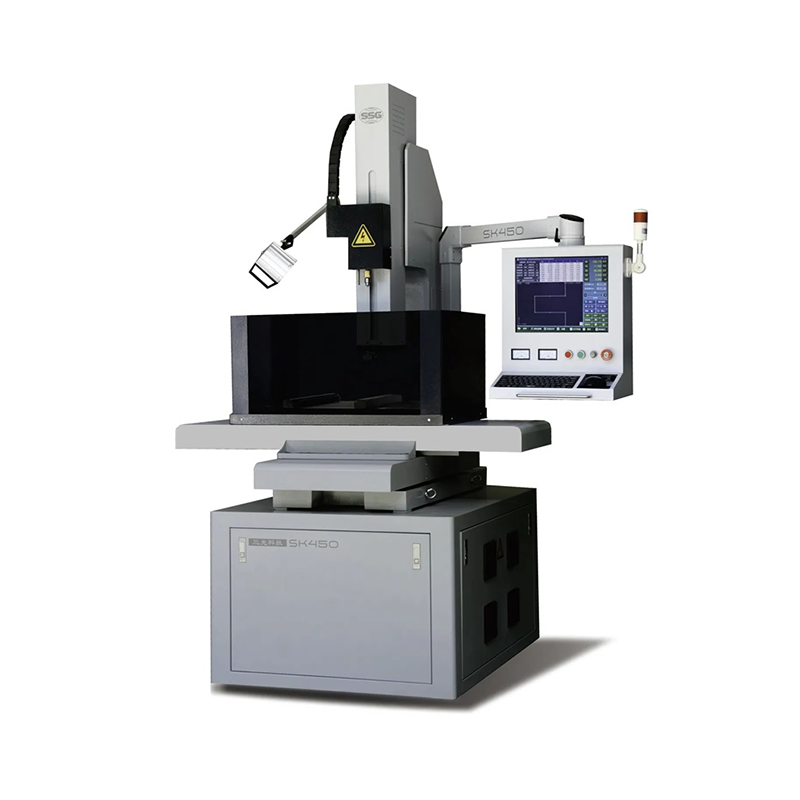
Looking at the broader landscape of aerospace manufacturing, a clear trend emerges toward higher thermodynamic efficiency. Next-generation jet engines must run hotter to achieve better fuel economy and higher thrust-to-weight ratios. This operational shift demands significantly more complex thermal management systems.
Engineers are designing turbine blades with intricate non-linear cooling passages and shaped diffuser holes that traditional machining simply cannot execute. As material scientists introduce even tougher single-crystal alloys and Ceramic Matrix Composites to survive these extreme environments, the reliance on mechanical drilling is rapidly diminishing. The industry is aggressively adopting non-contact thermal-electrical machining solutions. This transition is the only viable path forward to meet stringent new design geometries and strict metallurgical standards.
To clearly illustrate why aerospace manufacturers have shifted away from traditional methods, it is helpful to contrast the fundamental mechanics of both technologies.
Feature | Mechanical Drilling | Spark Erosion Machining |
|---|---|---|
Tool Contact | High friction and heavy shearing forces | Zero physical contact |
Material Hardness | Severely limits cutting speed and tool life | Completely irrelevant to cutting speed |
Burr Formation | Frequent internal burrs upon exit | 100% Burr-free entry and exit |
Tool Wear | Rapid, unpredictable degradation | Predictable, automatically compensated electrode wear |
Max Aspect Ratio | Limited, prone to severe tool deflection | Routinely achieves 100:1 or greater flawlessly |
The most significant limitation of mechanical drilling in micro-machining is the physical stress applied to the tool. Micro-drill bits often measure less than 1mm in diameter and are inherently fragile. When forced into a hard superalloy, the torsional stress frequently exceeds the structural integrity of the bit. If a bit breaks inside the internal cooling channel of a turbine blade, extracting it without damaging the surrounding metal is nearly impossible. This results in a scrapped part.
Because spark erosion is a non-contact process, the electrode never actually touches the workpiece. The electrical plasma channel bridging the gap removes the material. Without physical resistance, torsional stress, or friction, tool breakage is completely eliminated from the manufacturing equation. This allows operators to run machines unattended with total confidence.
In traditional machining, the fundamental rule states that the cutting tool must always be significantly harder than the workpiece material. As aerospace engineers develop tougher superalloys to increase engine efficiency, mechanical tooling struggles to keep pace. Even diamond-coated or solid carbide drills degrade rapidly when subjected to the abrasive nature of single-crystal titanium.
Implementing electrical discharge technology completely bypasses the hardness problem. The process relies entirely on the electrical conductivity of the material rather than its physical hardness or tensile strength. Whether the turbine blade is in an annealed state or fully hardened after heat treatment, the electrode will erode the material at a consistent and predictable rate.
Cooling holes in turbine blades are incredibly narrow and relatively deep. They require high depth-to-diameter aspect ratios. When a mechanical drill attempts to machine a deep hole, the long thin bit inevitably experiences deflection. It bends slightly under pressure, causing the hole to wander off its intended axis and potentially compromise the internal cooling geometry.
High-performance Small Hole EDM equipment excels at deep-hole drilling. It can routinely achieve aspect ratios of 100:1 or greater without any tool deflection. Because there is no physical cutting force pushing against the electrode, the hole remains perfectly straight and true to the programmed CNC coordinates. This ensures the internal passages connect exactly where the aerodynamic engineers intended.
Turbine blades feature highly contoured aerodynamic profiles. Cooling holes must often be drilled at acute angles, sometimes less than 20 degrees relative to the surface, to ensure the cooling air lays flat against the blade.
When a mechanical drill bit touches an angled curved metal surface, the tip naturally wants to slip down the incline. This requires specialized pilot holes or complex fixturing to prevent surface damage. Conversely, an EDM electrode simply lowers to the programmed spark gap distance and begins eroding the metal. The spark jumps directly to the closest conductive point. This allows for flawless entry on any contoured surface without slipping or scratching the expensive casting.
Mechanical shearing tears the metal at a microscopic level. As a drill bit breaks through the exit side of a hole, it inevitably pushes material outward, creating a sharp protrusion known as a burr. In aerospace applications, internal burrs are strictly forbidden. They disrupt airflow, create turbulence, and act as stress concentration points that can lead to metal fatigue. Removing burrs manually from inside a microscopic enclosed turbine blade channel is practically impossible.
Spark machining vaporizes the metal rather than tearing it. This thermal erosion process leaves a clean entry and exit. The resulting hole ensures unobstructed fluid dynamics, allowing the film cooling process to function exactly as designed without the need for expensive secondary deburring operations.
Manufacturing a turbine blade is an incredibly resource-intensive process long before the drilling stage even begins. The investment casting, directional solidification, and initial milling of a single-crystal superalloy blade can cost thousands of dollars per unit.
Relying on mechanical drilling introduces a substantial level of financial risk at the final stages of production. If a cheap mechanical drill bit wanders off-axis, creates an internal burr, or snaps inside the cooling passage, that expensive blade instantly becomes scrap metal. The high scrap rates associated with mechanical micro-drilling severely impact the overall profitability and yield of aerospace manufacturing lines.
Mechanical drill bits used on superalloys have an exceptionally short lifespan. In some demanding applications, a high-performance carbide drill bit may only successfully machine a handful of holes before its cutting edges degrade beyond acceptable aerospace tolerances. Manufacturers must maintain massive inventories of expensive drill bits and constantly halt production lines to change tooling.
In contrast, EDM electrodes are inexpensive consumable tubes made of basic brass or copper. While the electrode does slowly wear away during the sparking process, modern CNC generators automatically compensate for this wear in real-time. The cost per hole is drastically reduced, and machine uptime is significantly increased, making the total cost of ownership highly favorable.
When exploring advanced hole-making technologies, engineers often compare spark erosion to Electrochemical Machining. While EDM uses thermal energy to vaporize metal, Electrochemical Machining uses chemical dissolution. An electrical current is passed through a conductive electrolyte solution, which chemically dissolves the workpiece atom by atom. This process leaves absolutely no Heat Affected Zone and can machine multiple holes simultaneously using custom-shaped tooling.
Electrochemical Machining is exceptionally fast for high-volume mass production of identical parts. However, the tooling and setup costs are prohibitively high, and the process requires handling highly corrosive chemicals. For most aerospace manufacturers dealing with rapid prototyping, varying hole patterns, or small-to-medium batch sizes, advanced Small Hole EDM is vastly more flexible and cost-effective. It utilizes standard inexpensive tubular electrodes rather than custom-molded tools, providing the necessary precision without the massive upfront capital investment.
Investing in advanced machining technology requires understanding the specific demands of turbine blade production. Not all machines possess the precision necessary for aerospace applications. When evaluating equipment, engineers must prioritize specific technical parameters to ensure reliable production.
Specifically, a robust CNC Small Hole EDM machine should offer multi-axis capabilities, typically 5-axis or 6-axis, to position the workpiece precisely for complex angled holes. Look for systems capable of handling electrode diameters from 0.15mm to 3.0mm to cover a wide range of cooling hole specifications.
Furthermore, breakthrough detection is a critical feature. Advanced sensors detect the exact millisecond the electrode breaks through the inner wall of the turbine blade. The system instantly modifies the spark energy to prevent damaging the opposite internal wall. Additionally, features like an Automatic Electrode Changer allow for unattended continuous operation, minimizing downtime and maximizing overall yield. High-end power generators are also required to minimize the Heat Affected Zone, ensuring compliance with strict aerospace metallurgical standards.
While the aerospace sector drives much of the innovation in micro-hole machining, these capabilities translate perfectly to several other high-precision industries. In the automotive and heavy machinery sectors, diesel fuel injector nozzles require microscopic perfectly smooth holes to atomize fuel efficiently under extreme pressure. Mechanical drills struggle with the hardened steel used in these injectors, making spark erosion the standard choice.
Similarly, the medical device industry relies on this technology to machine surgical tooling and titanium orthopedic implants. The burr-free finish guarantees that no microscopic metal flakes are left behind in a patient. The non-contact process ensures that delicate thin-walled medical instruments are not crushed or deformed during manufacturing. Additionally, tool and die shops universally utilize these systems to create highly accurate starting holes for Wire-Cut operations.
The extreme environments of modern jet engines demand materials that push the absolute limits of metallurgy. Attempting to machine these hardened superalloys with traditional mechanical drills introduces unacceptable risks, ranging from broken tools and ruined castings to compromised airflow dynamics. Spark erosion has proven itself as the definitive solution for aerospace manufacturing.
By replacing physical friction with controlled thermal erosion, manufacturers gain the ability to drill deeper, cleaner, and more accurately on complex curved surfaces, regardless of material hardness. Transitioning to this advanced technology is a fundamental requirement for producing the safe, reliable, and highly efficient turbine blades that power today's aerospace industry.
If your production line struggles with high scrap rates, excessive tooling costs, or precision issues on hardened alloys, upgrading your machining capabilities is the next logical step. Explore high-performance solutions tailored to your exact specifications by visiting SSG EDM to find the right equipment for your facility.
Depending on the specific electrode used and the precision of the machine, this technology can typically drill holes down to 0.1mm to 0.15mm in diameter. Specialized micro-EDM machines can achieve even smaller diameters, making them perfect for intricate aerospace and medical applications.
Yes. Because it is fundamentally a thermal process, it creates a microscopic Heat Affected Zone, also known as the recast layer, along the edge of the hole. However, modern CNC generators tightly control the spark energy and duration to keep this layer extremely thin, ensuring it remains well within strict aerospace metallurgical tolerances.
For soft metals like standard aluminum or unhardened steel, mechanical drilling is usually faster. However, when working with aerospace superalloys like Inconel, Waspaloy, or single-crystal titanium, spark erosion is significantly faster and vastly more reliable. Mechanical drills must run at incredibly slow feed rates to prevent breaking in these hard metals, whereas the electrical process maintains a rapid consistent cutting speed regardless of hardness.
The only requirement for this process is that the workpiece must be electrically conductive. As long as the material conducts electricity, it can be machined effortlessly, regardless of its physical hardness. This includes standard steel, titanium, Inconel, tungsten carbide, aluminum, and various advanced aerospace alloys.
Breakthrough detection utilizes highly sensitive sensors within the power generator to monitor the voltage and current drop across the spark gap. The exact millisecond the electrode pierces through the inner wall of a hollow cavity, the electrical resistance changes. The machine instantly detects this shift and reduces power or retracts the electrode to prevent striking the opposite internal wall.
Yes. While tubular electrodes create perfectly round holes, aerospace engineers often use this process to drill the deep primary cooling channel. Once the pilot hole is established, manufacturers may use specialized sinker EDM with shaped electrodes to create the flared diffuser shapes at the surface of the turbine blade, optimizing the aerodynamic film cooling effect.
 HB400
 HB600
 HB800
 LA350A
 LA500A
 LA800
 EB450
 EA500A
 EB650N
 DS703C
 SK450


