
Machining ultra-hard alloys and complex, high-tolerance geometries presents a constant engineering challenge on the shop floor. Traditional contact machining methods cause unacceptable mechanical stress, rapid tool wear, and thermal distortion when applied to materials like tungsten carbide or Inconel. Selecting the wrong machining process or consumable for critical components introduces severe quality risks, leading to scrapped parts, compromised structural integrity, and missed tolerances.
Brass Wire EDM stands as the foundational standard for non-contact precision metal removal. By utilizing controlled electrical discharges, this process eliminates the physical cutting forces that plague conventional milling and turning. This article serves as a technical evaluation guide to determine when brass wire is the optimal choice for specific part requirements, material types, and production volumes on a modern Precision Wire EDM Machine.
Material Versatility: Brass Wire EDM is highly effective for conductive, difficult-to-machine metals including carbide, tungsten, Inconel, and titanium, eliminating contact-related mechanical damage.
Optimal Balance: Plain brass wire offers the industry-standard baseline for balancing cutting speed, electrical conductivity, tensile strength, and consumable cost.
Geometric Precision: Ideal for achieving tight tolerances, sharp internal corners, and superior surface finishes in tool and die making, aerospace, and medical device manufacturing.
Process Limitations: While highly accurate, the process is limited to electrically conductive materials and may require post-processing to manage the thermal recast layer.
The fundamental principle of electrical discharge machining involves utilizing high-frequency, high-temperature electrical sparks to erode material. These sparks, ranging from 8,000°C to 12,000°C, are generated between the brass wire and the workpiece. The localized heat vaporizes the metal, creating a precise kerf without physical contact. The power generator controls the on-time and off-time of these discharges, dictating the aggressiveness of the cut and the resulting surface finish.
Deionized water or specialized dielectric fluid plays a critical role in this operation. The fluid flushes vaporized debris away from the cutting zone, cools the localized area to prevent widespread thermal distortion, and controls the spark gap. The absence of physical cutting force prevents mechanical distortion, deflection, and tool vibration. This non-contact nature allows operators to machine delicate, thin-walled structures that would collapse under the pressure of a traditional end mill. Maintaining a consistent spark gap, typically between 0.0005 and 0.002 inches, ensures dimensional accuracy across the entire cut profile.
Brass is the standard consumable in wire EDM due to its specific metallurgical properties. Typically composed of an alloy containing 60-65% copper and 35-40% zinc, it offers a necessary balance for stable spark erosion. Copper provides the high electrical conductivity required for efficient spark generation, while zinc offers a lower melting point and vaporization temperature. This combination allows the wire to carry high currents while the zinc vaporizes to help clear the kerf.
The presence of zinc improves gas flushing within the kerf and increases overall cutting speed. Wire tensile strength, which can range from 400 to over 1000 N/mm², dictates how well the wire handles high-tension environments. High tensile strength combined with appropriate elongation properties ensures mechanical stability during high-speed taper cuts and prevents premature wire breakage. Hard brass wire is typically used for straight cuts requiring high tension, while half-hard or soft brass wire is preferred for extreme taper cutting where the wire must bend sharply around the guides.
Wire Type | Tensile Strength (N/mm²) | Elongation (%) | Primary Application |
|---|---|---|---|
Hard Brass | 900 - 1100 | < 2% | High-precision straight cuts, automatic threading |
Half-Hard Brass | 500 - 700 | 10 - 15% | Moderate taper cuts, general purpose |
Soft Brass | 350 - 450 | > 20% | Extreme taper cuts (up to 45 degrees) |
In the tool and die industry, precision is non-negotiable. Brass wire EDM excels at cutting hardened tool steels, D2, and tungsten carbide. The process eliminates the need for pre-machining annealing or post-machining hardening, as the material hardness does not affect the electrical erosion rate. Machining parts in their fully hardened state prevents the dimensional warping that typically occurs during heat treatment.
Manufacturers rely on this technology to produce extrusion dies, blanking punches, and complex mold cavities. The ability to cut intricate keyways and pocket geometries with ultra-sharp internal corners makes it indispensable for creating the tooling required for mass production. A standard workflow for creating a high-precision stamping die involves several distinct steps:
Heat treating the raw tool steel block to the final required hardness (e.g., 60-62 HRC).
Grinding the top and bottom surfaces to establish parallel reference planes.
Drilling a starter hole using a hole popper (small hole EDM).
Threading the brass wire through the starter hole.
Executing a roughing cut to remove the bulk of the material.
Performing two to four skim passes to achieve the final dimensional tolerance and surface finish.
Aerospace and medical manufacturing frequently involve exotic, heat-resistant superalloys like Inconel, titanium, and Nitinol. Traditional CNC milling struggles with these materials, causing rapid tool wear and surface work-hardening. Wire EDM bypasses these issues entirely, as the electrical discharge process does not rely on the physical hardness of a cutting tool to shear the material.
The process delivers burr-free, microscopic finishes essential for critical components. Surgical instruments, orthopedic implants, and aerospace turbine slots require flawless edges to ensure safety and performance. The non-contact erosion guarantees that the structural integrity of these sensitive parts remains intact, preventing the introduction of residual mechanical stresses that could lead to premature fatigue failure in the field.
Advanced manufacturing often demands narrow kerf widths and complex internal features. Wire EDM can utilize wire diameters down to 0.1 mm or less, enabling extreme micro-machining. Operators can produce steep tapers up to 30-45 degrees and sharp internal radii with high repeatability. This capability is essential for manufacturing miniature gears, fluidic channels, and micro-connectors.
A modern precision wire EDM machine achieves high-aspect-ratio cuts, such as deep slots in thick plates, that are physically impossible with traditional rotating cutting tools. The wire maintains a straight cutting path through thick materials without the deflection associated with long, thin end mills. When cutting a 4-inch thick block of steel, a 0.010-inch diameter wire will remain perfectly vertical, whereas a milling cutter of similar diameter would snap instantly upon contact.
While plain brass serves as the industry standard, specialized wires offer distinct advantages. Zinc-coated and diffusion-annealed wires provide enhanced cutting speeds, superior surface finish capabilities, and improved spark stability. The zinc coating vaporizes quickly, cooling the wire and protecting the core from thermal degradation. This allows the machine generator to push higher amperage without breaking the wire.
The higher cost of coated wires is often justified in specific scenarios. When production demands a 20-30% increase in cutting speed or when machining exceptionally thick workpieces where wire breakage is a primary concern, the investment in zinc-coated or diffusion-annealed wire yields a positive return. Diffusion-annealed wire, where the zinc coating is alloyed into the copper core through a heating process, offers the best performance for aggressive roughing cuts in tall workpieces.
Wire Type | Relative Cutting Speed | Cost Factor | Best Use Case |
|---|---|---|---|
Plain Brass | 1.0x (Baseline) | Low | General purpose, standard tolerances |
Zinc-Coated | 1.15x - 1.20x | Medium | High-speed roughing, improved flushing |
Diffusion-Annealed | 1.20x - 1.30x | High | Tall workpieces, aggressive cutting parameters |
For ultra-fine diameter cutting, often referred to as micro-EDM, molybdenum and tungsten wires offer superior tensile strength compared to brass. These materials withstand the high tension required to keep microscopic wires straight during the cutting process. When working with wire diameters below 0.004 inches (0.1 mm), brass lacks the structural integrity to maintain tension without stretching or breaking.
Unlike brass wire, which is wound continuously from a spool and used only once, molybdenum wire is often reusable in specific high-tension, micro-tolerance setups. The selection decision between these wire types depends heavily on part size, required corner radii, and the overall consumable budget for the project. Tungsten wire provides the absolute highest tensile strength but comes at a significant premium, reserving its use for the most demanding micro-machining applications.
Achieving realistic surface finish expectations requires precise control over machine parameters. Modern equipment can achieve finishes down to 0.1 μm Ra or better, frequently eliminating the need for secondary grinding operations. This is accomplished through a series of skim passes, where the generator power is progressively reduced, and the wire offset is adjusted to shave microscopic amounts of material from the cut surface.
Dimensional accuracy depends on several factors. Wire diameter dictates the minimum internal corner radius. Tension control ensures the wire remains straight during the cut. Power generator settings, specifically pulse duration and frequency, directly impact the crater size left by each spark, determining both the final surface finish and the dimensional tolerance. Thermal stability of the machine environment is also critical; a fluctuation of just a few degrees in ambient room temperature can cause thermal expansion in the machine casting, throwing off tolerances by several tenths of a thousandth of an inch.
The condition of the dielectric fluid is critical for maintaining spark consistency. The conductivity and cleanliness of the water directly impact spark gap maintenance. If the water becomes too conductive, sparks will jump prematurely, degrading accuracy and causing erratic cutting behavior. The dielectric fluid acts as an insulator until the exact moment the voltage overcomes the gap distance.
Deionization resins and paper cartridge filters are essential components of the fluid system. The resins maintain the correct electrical resistance of the water, while the filters prevent the re-deposition of eroded metallic particles back onto the workpiece or into the cutting kerf. Operators must monitor water conductivity levels daily and replace resin tanks when the micro-siemens reading exceeds the machine manufacturer's recommended threshold.
Effective flushing removes eroded particles from the kerf, preventing secondary sparking and wire breakage. Part thickness and nozzle positioning heavily influence flushing efficiency. Thicker parts restrict fluid flow, requiring higher pressure to clear the debris. The upper and lower flush nozzles must be positioned as close to the workpiece surface as possible—typically within 0.005 inches—to force the water directly through the cut.
Poor flushing leads to compromised dimensional tolerances and significant machine downtime. Operators must carefully configure high-pressure versus low-pressure flushing cycles based on the geometry of the cut and the stability of the workpiece to ensure consistent erosion. When cutting near the edge of a part or machining a delicate feature, high-pressure flushing can physically deflect the wire or the workpiece, necessitating a switch to low-pressure flushing and a corresponding reduction in cutting speed.
Electrical discharge machining requires the workpiece to conduct electricity. The baseline electrical conductivity determines whether a material is viable for the process. While standard metals pose no issue, specialized conductive ceramic materials and certain semiconductor substrates can also be machined, provided their resistance falls within acceptable parameters. If a material is non-conductive, the spark cannot form, and the process will not work. Surface contaminants, such as heavy rust, scale, or non-conductive coatings, must be removed prior to machining to establish a solid electrical ground.
The rapid melting and cooling inherent in the EDM process leave a thermal recast layer, often called the white layer, and a heat-affected zone (HAZ) on the cut surface. This metallurgical reality can affect the fatigue life of critical components. The recast layer is typically very hard and brittle, containing micro-cracks that can propagate under cyclic loading.
Mitigation strategies are essential for aerospace or medical parts. Implementing multi-pass skim cuts removes the majority of the recast layer, reducing its thickness from several microns down to a fraction of a micron. For fatigue-critical applications, chemical etching or secondary mechanical polishing may be required to completely eliminate the HAZ and restore the material's original surface integrity. Understanding the depth of the HAZ for different materials allows engineers to specify the correct number of skim passes required to meet part specifications.
Single-use brass wire represents a continuous operational cost. Analyzing wire consumption rates is necessary for accurate job quoting and budget management. Wire breakage immediately halts production and impacts machine downtime. When a wire breaks, the machine must re-thread the wire, return to the exact point of breakage, and resume cutting without leaving a witness mark on the part.
Root causes of wire breakage include poor flushing, incorrect tension settings, aggressive feed rates, or dirty electrical contacts. Proper machine maintenance and conservative parameter selection are required to mitigate these risks and maintain steady production throughput. Regularly cleaning the power feed contacts and ensuring the wire guides are free of debris will significantly reduce the frequency of unexpected wire breaks during long, unattended machining cycles.
Wire EDM has a relatively slow material removal rate (MRR) compared to high-speed CNC milling. This process is generally unsuitable for simple, high-volume production where cycle time is the primary metric. Machining a large pocket out of a block of aluminum is far faster on a milling machine than burning it out with wire EDM.
However, the return on investment is highly favorable for prototyping, complex low-volume runs, and machining hard metals. Stack cutting, which involves machining multiple thin sheets simultaneously, significantly increases throughput for specific part geometries, making the process highly cost-effective in the right applications. By stacking twenty 0.050-inch thick plates and cutting them in a single setup, the effective cycle time per part drops dramatically, rivaling the output of a stamping press for short-run production.
Brass wire EDM remains the most reliable and cost-effective method for high-precision machining of conductive hard metals. When geometric complexity and tight tolerances supersede raw material removal speed, this non-contact process delivers results that traditional milling cannot match. Understanding the mechanics of spark erosion, the properties of different wire types, and the critical importance of flushing and dielectric fluid maintenance ensures successful implementation on the shop floor.
When evaluating a machining partner or purchasing equipment, assess the generator technology, automatic wire threading capabilities, thermal stability of the machine bed, and the required operator expertise. These factors dictate the ultimate success of the implementation and the quality of the finished components.
Submit a CAD model for a manufacturability review to determine if wire EDM is the correct process for your geometry.
Request a technical consultation on wire selection based on your specific material requirements and tolerance specifications.
Review detailed machine specifications, focusing on generator capabilities and thermal stability, to determine the feasibility of in-house adoption.
Establish a strict maintenance schedule for dielectric fluid filtration and power contact cleaning to ensure consistent machine performance.
A: The process can cut any electrically conductive material. Common applications include hardened steel, aluminum, brass, titanium, Inconel, tungsten carbide, and specialized conductive ceramics. Material hardness does not affect the cutting process.
A: Under temperature-controlled conditions, standard tolerances typically reach down to +/- 0.0001 inches or +/- 2.5 microns. Achieving these tolerances requires proper machine maintenance, high-quality wire, and multiple skim passes.
A: Zinc lowers the melting point and enhances vaporization, which improves flushing and increases cutting speed. The brass alloy also provides higher tensile strength relative to pure copper, preventing wire breakage under high tension.
A: No. The non-contact nature of the spark erosion process results in completely burr-free edges, eliminating the need for manual deburring operations after machining. This is ideal for delicate or complex profiles.
A: Thicker parts restrict the flow of dielectric fluid, reducing flushing efficiency. This makes it harder to maintain a stable spark gap across a taller profile, thereby slowing the overall cutting speed and increasing the risk of wire breakage.
A: No. The process relies on electrical sparks, meaning only electrically conductive materials or specialized conductive ceramics can be machined. Pure polymers and standard ceramics are non-viable because they cannot complete the electrical circuit.
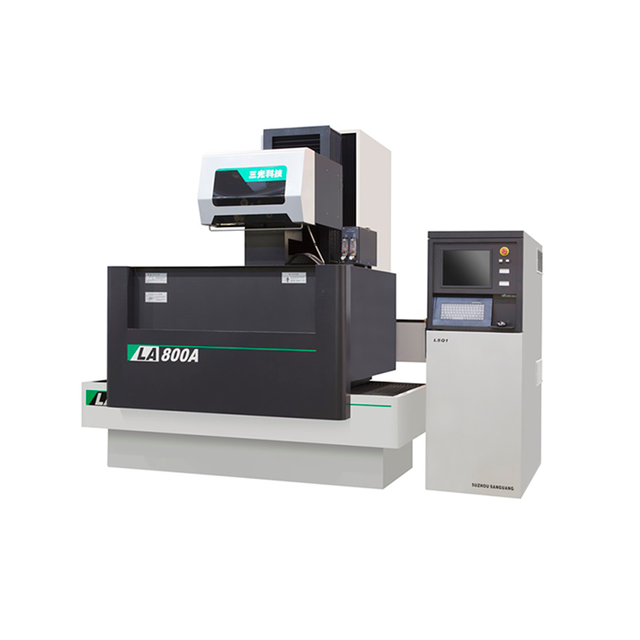


 HB400
HB400  HB600
HB600  HB800
HB800  LA350A
  LA500A
  LA800
LA800  EB450
EB450  EA500A
  EB650N
  DS703C
  SK450
SK450 


