
In wire electrical discharge machining, selecting the wrong wire tensile strength does not just cause premature breakage. It actively sabotages automatic wire threading (AWT) systems and ruins unattended production runs. Many shop managers treat tensile strength as a simple metric where higher always equals better. In reality, tensile strength dictates a strict trade-off between straight-line automation reliability and taper-cutting flexibility. Measured in PSI or N/mm², this physical property governs how well your machine performs under mechanical load.
Choosing the ideal tensile strength for your Brass Wire EDM operations requires carefully aligning the wire’s properties with your specific part geometry. You must also factor in your generator type and your lights-out automation goals. We will explore how to balance straight-cut speed with angle-cutting flexibility. You will learn to identify metallurgical limits and avoid common failure points. This ensures you maintain peak production efficiency.
Hard Brass Wire (>900 N/mm²): Essential for reliable Automatic Wire Threading (AWT), lights-out machining, and cutting tall workpieces without wire deflection.
Soft Brass Wire (~400-500 N/mm²): Mandatory for extreme taper cutting, as its high elongation allows it to bend through guides without snapping.
Metallurgical Limits: The ideal copper-to-zinc ratio (typically 63/37 or 60/40) maximizes cutting speed; exceeding 40% zinc makes the wire too brittle for consistent drawing, regardless of stated tensile strength.
Hidden Failure Points: Wire breakage is often misdiagnosed as a tensile strength failure when the real culprit is poor flushing balance or paraffin wax buildup in the wire guides.
Tensile strength represents a material's resistance to stretching and breaking under a heavy load. In precision machining, this metric directly controls how much mechanical tension the equipment can apply to the spool. High tension keeps the cutting tool perfectly straight. If you apply too much tension to a weak wire, it snaps immediately. If you apply too little tension, the wire bows and ruins your dimensional accuracy.
Industry suppliers establish baseline metrics to classify these consumables. We measure this strength in either Pounds per Square Inch (PSI) or Newtons per square millimeter (N/mm²). Standard ranges typically stretch from 54,000 to 173,000 PSI. This roughly equates to 400 to 1100 N/mm². Understanding these numbers helps you map the consumable exactly to your daily operational demands.
Wire Classification | Tensile Strength (N/mm²) | Tensile Strength (PSI) | Primary Application |
|---|---|---|---|
Soft / Half-Hard | 400 - 500 N/mm² | 54,000 - 75,000 PSI | Extreme taper angles, complex profiles |
Standard / Hard | 900 - 1000 N/mm² | 130,000 - 145,000 PSI | Straight cuts, general automation |
Ultra-Hard | > 1000 N/mm² | > 145,000 PSI | Tall workpieces, extreme high-tension skim passes |
The manufacturing process relies heavily on the zinc-hardness correlation. Copper provides the conductive core, while zinc acts as the cutting catalyst. Higher zinc content increases vaporization efficiency. Zinc vaporizes quickly, which carries heat away from the spark gap. This cooling effect allows for higher cutting speeds. Adding zinc also increases the potential hardness of the alloy.
However, metallurgists face a strict limit. Pushing past the 40% zinc threshold forces the alloy into the "gamma phase." At this point, the material becomes incredibly brittle. It loses its ability to withstand standard tensioning during the drawing process. You cannot easily pull it into continuous, uniform spools. Therefore, standard high-tensile brass maximizes the zinc ratio just below this critical breaking point.
We define "Hard" wire as having a tensile strength typically between 900 and 1100 N/mm². This translates to over 130,000 PSI. Its most defining characteristic aside from strength is its exceedingly low elongation rate. Hard wire stretches very little before it breaks. This rigidity makes it the undisputed standard for straight-line accuracy and automated manufacturing workflows.
High tensile strength is non-negotiable for modern Automatic Wire Threading (AWT) systems. These mechanisms require the wire to maintain physical "memory." When the machine shears the wire, a hard alloy remains perfectly straight at the tip. It does not curl or deflect. This straightness prevents the tip from jamming inside closed diamond guides during an automatic re-thread cycle. Successful AWT relies entirely on this predictable, rigid behavior.
This reliability directly enables lights-out machining. Unattended manufacturing is the ultimate goal for modern machine shops. You load large spools weighing 35 to 50 lbs onto the equipment. Hard wire allows continuous 40-hour production runs. If the wire happens to break during a night shift, the machine simply rethreads itself. It resumes the cut without human intervention. You maintain maximum uptime.
Tall workpiece stability presents another major advantage. Cutting thick parts requires aggressive dielectric flushing pressures to clear debris from the kerf. High fluid pressure physically pushes against the wire. Hard wire withstands the high mechanical tension required to resist this force. It prevents the tool from "barreling" or bowing in the middle of tall parts. You achieve perfectly straight vertical walls.
Straightness Memory: Ensures the cut tip enters guide blocks without snagging.
High Tension Capacity: Resists aggressive fluid dynamics in deep cuts.
Sub-Micron Precision: Maintains absolute verticality on heavy workpieces.
AWT Compatibility: Drives near-100% success rates for automated recovery.
We define "Soft" wire by its lower strength, typically ranging from 400 to 500 N/mm² (54,000 to 75,000 PSI). Its core feature is a high elongation percentage. Soft wire can stretch up to 20% or more before snapping. This extreme flexibility fundamentally changes how it interacts with the machine's guide components. It offers capabilities that rigid alloys simply cannot match.
The primary advantage of soft material lies in taper cutting. When you program a machine to cut steep angles, the wire must bend sharply. It exits the upper guide and enters the lower guide at a severe slope. High-tensile wire resists this bend. It creates massive friction against the diamond guides. It often snaps under the stress or damages the guide itself. Soft brass easily conforms to these extreme taper angles. It maintains a smooth, continuous path through the upper and lower blocks.
However, this flexibility introduces a significant operational trade-off. Soft wire is highly prone to AWT failures. Because it stretches easily, it lacks rigid memory. After a cut, the tip frequently curls or bends slightly. A curled tip cannot navigate the tiny orifice of an automatic threading mechanism. It jams against the surrounding block.
If a soft wire breaks during an unattended shift, the equipment will likely fail to rethread. The machine stops. It sits idle until an operator arrives in the morning to manually thread it. You sacrifice overnight automation capability to gain angle-cutting flexibility. This is why shop managers reserve soft alloys specifically for jobs requiring intense angular geometries.
You must map your consumable choices to your specific equipment origins. Japanese machine manufacturers build their generators around specific standards. Brands like Sodick, Fanuc, and Mitsubishi optimize their standard cutting technologies for 60/40 hard brass wire. They achieve incredible speeds and finishes using basic high-tensile materials.
European machines utilize different generator philosophies. Equipment from manufacturers like AgieCharmilles often requires specific tensile characteristics. They frequently recommend proprietary coated wires to maximize their unique power curves. Using standard hard brass on these machines might result in suboptimal speeds. You should always consult your builder’s consumable matrix before placing bulk orders.
The cutting environment dictates success just as much as the metal itself. High-pressure flushing is absolutely required to remove microscopic ash and debris from the kerf. Clean fluid prevents secondary sparking. However, you must carefully evaluate your nozzle balance.
If your upper and lower flush nozzles are unbalanced, they create severe turbulence. This creates a "rooster tail" effect where fluid blasts out one side of the cut unevenly. This unbalanced hydraulic force violently pushes the wire. Even the highest tensile wire will snap under these chaotic conditions. You must balance the fluid dynamics before blaming the spool.
Achieving superior surface finishes requires a multi-pass process. The initial rough cut prioritizes material removal speed. Subsequent "skim cuts" focus entirely on accuracy and smoothness. During a skim cut, the machine lowers the electrical power significantly.
It simultaneously increases the mechanical tension. This combination acts like a finely tuned violin string gently removing microscopic layers of metal. High tension is critical to achieve sub-micron surface finishes between 1.0 and 2.0 μm Ra. Hard wire holds this strict dimensional tolerance much better than soft wire. It refuses to deflect during the delicate final passes.
Operation Type | Wire Recommendation | Reasoning |
|---|---|---|
High-Speed Straight Cutting | Hard Brass (60/40) | Withstands high flush pressure, maintains verticality. |
Steep Taper (>15 Degrees) | Soft Brass | High elongation allows bending without guide friction. |
Sub-Micron Skim Passes | Ultra-Hard Brass | Holds extreme tension for micro-layer removal. |
Lights-Out Automation | Hard Brass | Straight tip memory guarantees AWT success. |
Many operators fall into the "tensile strength trap." They assume that a breaking wire automatically means they need a stronger product. They immediately order spools with higher PSI ratings. This assumption frequently masks underlying mechanical or environmental problems. Throwing harder metal at a badly tuned machine only damages your guides faster.
The paraffin contamination risk stands out as a hidden industry danger. Some manufacturers coat their cheap brass wires in drawing lubricants. Paraffin wax helps the material slide through their factory dies. Unfortunately, they leave this wax on the final product. This wax melts during machining and builds up inside your closed wire guides. It also coats the power contacts.
This buildup creates severe micro-friction. The wax physically grips the wire as it travels. This resistance causes tension spikes that snap even premium 1100 N/mm² wire. You must always recommend specifying "paraffin-free" products from your distributor. Clean guides are mandatory for consistent tension control.
You must also analyze your tension versus spark gap adjustments. Operators should verify their discharge settings before blaming material strength. The machine feeds the consumable forward while electrical sparks vaporize the workpiece ahead of it. The wire should never physically touch the steel.
If your feed rate pushes the wire faster than it can vaporize the steel, physical contact occurs. This causes a direct short circuit. The machine either halts or the physical collision snaps the line instantly. It will break regardless of its PSI rating. Use this structured approach to troubleshoot breakage:
Check Fluid Balance: Ensure upper and lower nozzles output equal pressure to avoid turbulent deflection.
Inspect Power Contacts: Look for grooves or paraffin wax buildup causing unnecessary friction.
Verify Spark Gap: Confirm your feed rate matches your vaporization speed to prevent physical collisions.
Examine Cutters: Ensure the AWT shears are sharp. Dull blades create burred tips that jam during threading.
Selecting the optimal consumable strength for your machining process requires a strategic approach rather than a guessing game. You should rely on a definitive baseline recommendation: default to high-tensile brass for 80% of your standard applications. Hard alloys deliver the rigid memory necessary for uninterrupted automatic threading. They provide the mechanical stability required to withstand aggressive flushing on tall workpieces.
You should shift to half-hard or soft varieties only when facing specific geometric challenges. Reserve these highly elongating alloys for jobs where taper angles exceed the physical bending limits of rigid materials. The flexibility prevents guide friction but sacrifices your ability to run unattended overnight shifts.
Always align your consumable purchases with your machine builder's guidelines. Consult the manufacturer’s matrix to confirm compatibility with your specific generator curves. By prioritizing paraffin-free products and balancing your flush pressures, you will eliminate the hidden variables that cause premature breakage. You will achieve faster cuts, smoother finishes, and highly reliable automation.
A: You can only use it for very shallow tapers. Steep tapers require the wire to bend sharply at the upper and lower guide blocks. High-tensile wire is rigid and will snap or cause severe friction under these conditions. Extreme angles require soft wire's elongation properties to bend smoothly.
A: Not directly. Cutting speed is primarily driven by the wire's electrical conductivity and zinc vaporization point. However, higher tensile strength prevents bowing. This allows you to run more aggressive flushing pressures. Better flushing clears debris out of the kerf faster, which indirectly allows you to maximize cutting speeds.
A: Breakage during threading usually stems from mechanical interference. Check for wire curling off the spool due to bad tensioning. Inspect the wire-cutters on the machine; dull blades leave a burred tip that catches on guides. Finally, check for hidden paraffin wax buildup clogging the closed guide pathways.

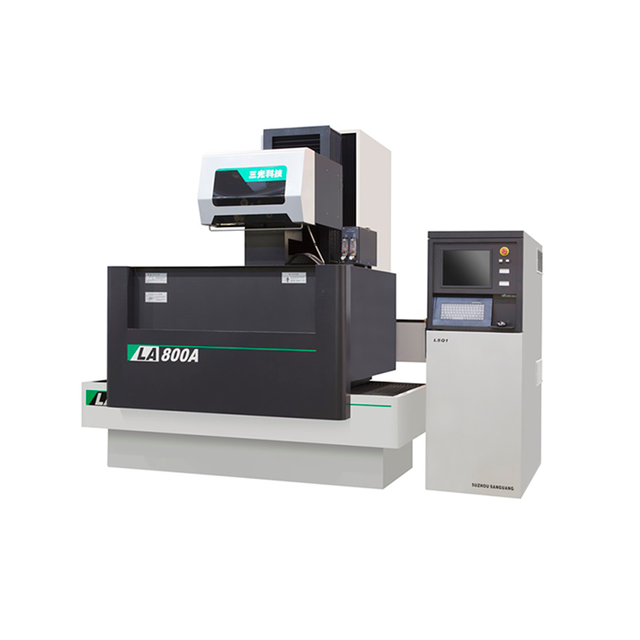
 HB400
HB400  HB600
HB600  HB800
HB800  LA350A
  LA500A
  LA800
LA800  EB450
EB450  EA500A
  EB650N
  DS703C
  SK450
SK450 


