
Standard plain wire serves as the undisputed workhorse for electrical discharge machining. You will find it powering over 80% of everyday cutting applications across machine shops globally. However, engineers in aerospace, medical device manufacturing, and precision mold-making frequently demand pristine, mirror-like surface finishes. These industries operate under strict dimensional controls.
Many procurement teams assume achieving these pristine surfaces automatically dictates expensive coated wires. They often default to intense secondary mechanical polishing. This misconception frequently leads to bloated manufacturing budgets. It creates unnecessarily complex routing processes on the shop floor. Shop managers struggle constantly. They must balance the high price of premium consumables against the actual surface requirements of the engineered part.
The truth is standard plain wire can achieve highly refined surface finishes down to 8 μin (Ra 0.2 µm). Hitting this strict threshold requires highly disciplined multi-pass machining strategies. It demands exceptional machine calibration. In this guide, we will explore exactly how skimming techniques work. We will outline when to upgrade your consumables. Finally, we will show you how to optimize your part designs for peak surface quality.
Capability Limit: Standard plain brass wire can achieve surface finishes as fine as 8 to 16 μin (Ra 0.2 to 0.4 µm) through controlled multi-pass cutting.
The Cost of Quality: Achieving micro-inch finishes with brass requires up to 4+ skim passes, significantly reducing material removal rates and increasing machine time.
Wire Selection Threshold: For production runs requiring consistent finishes below 16 μin without sacrificing cycle times, hybrid or coated wires (e.g., A-type or Gamma-phase) typically offer a better ROI than plain brass.
Zero Mechanical Stress: Unlike conventional milling, wire EDM’s non-contact electro-erosion process guarantees no tool-induced directional distortion, regardless of material hardness.
Before you authorize an upgrade to premium coated consumables, you must understand the true limits of a standard setup. Engineers often wonder if standard wire can handle critical aerospace tolerances. It absolutely can. Shop floors rely on it daily for complex geometry generation.
A single rough cut using standard 0.010-inch plain wire yields a relatively coarse finish. You can expect roughness values around Ra 2.5 to 3.2 µm. The spark aggressively tears away bulk material. This leaves distinct craters along the cut path. This surface grade works perfectly for functional brackets. It also suits basic cutting tools or general structural components. Edge finish remains non-critical in these applications. The primary goal during a rough pass is sheer speed.
You can push plain wire much further. By applying sequential skim passes, plain material realistically reaches 8 μin (Ra 0.2 µm). Experts note a crucial detail here. The limitation at this ultra-fine level rarely involves the wire itself. Instead, machine power supply capabilities dictate the final quality. Advanced fine-finish pulse control matters deeply. The machine must modulate energy delivery in microseconds. Precision dielectric flushing plays an equally vital role. The water must carry away microscopic debris instantly. If debris lingers, it arcs against the wire and ruins the finish.
People often confuse dimensional accuracy and surface roughness. They treat them as independent variables on a blueprint. Achieving a ±0.0001-inch (±0.002 mm) dimensional tolerance inherently requires multiple skim passes. These exact same passes naturally produce fine surface finishes. You cannot separate tight tolerances from smooth edges during this process. A shop quoting a high-tolerance part will inevitably deliver a smooth part. The physics of electrical erosion demand it.
Buyers evaluating machining quotes and lead times often misunderstand the multi-pass process. They see multiple passes and assume inefficiency. Let us demystify how skimming actually engineers the final surface. It is a highly controlled, sequential refinement.
Phase 1: The Rough Cut (Bulk Material Removal): This initial stage uses high voltage, high amperage, and high wire tension. It aggressively creates the initial shape of your part. The wire punches through the metal rapidly. However, this brute-force step leaves behind a thicker thermal recast layer. Machinists call this the "White Layer." The extreme heat alters the metallurgical structure of the edge. It also leaves microscopic, jagged craters across the entire cut zone.
Phase 2: Intermediate Skim Passes (Geometry Correction): During the second phase, operators adjust the wire offset inward. They step down the voltage significantly. They reduce the flushing pressure to prevent wire vibration. This pass removes any wire-lag deflection leftover from the rough cut. The wire straightens out perfectly. It begins shaving down the thick recast layer. The machine removes material in incredibly tiny increments. These cuts can measure as small as 0.0001 inches. The surface topography begins to smooth out noticeably.
Phase 3: The Final Finish Passes (Surface Refinement): The machine now switches to low-energy, high-frequency sparking. It delivers rapid, tiny pulses of energy. It eliminates virtually all localized thermal defects. Vaporization occurs rapidly between 8,000 and 12,000 °C. This extreme heat leaves a microscopic, uniform finish. The craters become so small they blend together. Depending on the settings, you get a beautiful satin matte or near-mirror reflection. The mechanical integrity of the edge is fully restored.
Choosing the right consumable requires a clear decision framework. You must know exactly when to abandon standard options. Making the wrong choice directly impacts your production schedule and profit margins.
Plain wire excels during prototyping and low-volume runs. It works beautifully when machine time remains highly available. Shops often run lights-out or unmanned machining overnight. This idle availability easily compensates for slower skim speeds. You pay less for the wire and utilize open off-shift hours. You should also stick to plain wire when your target finish sits between Ra 0.8 µm and Ra 0.4 µm. You can easily achieve this range using just two or three simple passes. Standard consumables handle this workload flawlessly.
Sometimes you need advanced solutions like zinc-coated or gamma-phase wires. Consider the speed factor first. Coated wires achieve the exact same fine finish in fewer passes. For example, they can hit 16 μin (Ra 0.4 µm) in just three passes instead of four or five. The zinc coating vaporizes early. This cools the core wire and allows higher cutting energy. Next, consider the quality ceiling. High-end diffusion-annealed wires heavily mitigate flaking. They prevent unwanted brass transfer onto the workpiece. This pure cutting action is absolutely critical for medical implants or semiconductor components. These industries strictly forbid foreign material contamination.
Let us look at the cost-to-outcome matrix. Plain wire costs very little to buy upfront. However, it demands extensive machine time to produce fine finishes. You trade machine capacity for cheap consumables. Conversely, coated wire costs much more upfront. Yet, it reduces total machine time by up to 30%. High-volume production lines almost always justify the expensive coated wire. The time savings pay for the premium wire tenfold.
Many advanced manufacturing facilities rely heavily on Brass Wire EDM for the bulk of their workload. They only swap out for coated options when strict cycle times dictate the change.
Wire Category | Upfront Cost | Passes Required for Ra 0.4 µm | Ideal Production Scenario |
|---|---|---|---|
Standard Plain Brass | Low | 4 to 5 passes | Prototyping, Unmanned lights-out runs |
Zinc-Coated | Medium | 3 passes | High-speed production, General precision |
Hybrid Gamma-Phase | High | 2 to 3 passes | Ultra-pure medical/aerospace parts |
Experienced engineers know wire selection alone cannot guarantee a perfect finish. Several hidden factors can easily ruin your final surface. You must tightly control the entire machining environment.
Dielectric Fluid Condition: Dirty deionized water severely disrupts the electrical spark gap. This gap typically measures just 0.01 to 0.05 mm. Contaminated fluid causes highly unstable arcing. Stray particles act as conductive bridges. This instability leads directly to microscopic pitting on your otherwise fine finish. Operators must maintain strict filtration schedules. They must monitor resin bed life constantly.
Part Geometry and Flushing Limitations: Blind cavities present massive challenges. Excessively thick workpieces also prevent optimal fluid flushing. Poor flushing traps microscopic debris inside the cut channel. This debris drags aggressively against the part walls. It immediately ruins the expected Ra value. Operators sometimes build custom flushing nozzles. They do this to force water into difficult geometric pockets safely.
Material Impurities: Base metals often hide inclusions or hard spots. You will find these even in premium tool steels or aerospace-grade titanium. These hard spots force the cutting wire to deflect slightly. Deflection completely negates the extreme precision of a final skim pass. You end up with a visible line or a dimensional deviation. Sourcing high-quality, vacuum-melted metals helps eliminate this unpredictable variable entirely.
Procurement teams and engineering departments need clear drafting guidelines. How you draft your manufacturing prints directly impacts your quotes. A poorly marked drawing invites massive price markups.
You must avoid over-specifying. Do not default to calling out ISO 2768 fine tolerances globally. You should never demand Ra 0.2 µm across an entire part if only the mating surfaces require it. Every single unnecessary skim pass drives up the part cost exponentially. Only specify extreme finishes where they actually matter mechanically. Mark the specific edges needing refinement. Leave non-functional edges at a standard rough-cut finish. This targeted approach saves thousands of dollars in production costs. It shows the machine shop you thoroughly understand the process.
You must also address the recast layer. Consider the operational environment of your part. Components subjected to high cyclic fatigue require special attention. Aerospace turbine components serve as a prime example. You must explicitly specify "recast layer removal" alongside your desired Ra value. A visually fine electrical discharge finish might look perfect to the naked eye. However, it still contains microscopic thermal stress. You may require micro-blasting or electropolishing. These secondary steps remove the final atomic layers of stressed metal. They ensure absolute structural integrity under extreme dynamic loads.
Plain wire remains highly capable of producing strict, mirror-like surfaces. Success relies heavily on disciplined multi-pass machining and highly optimized power supply settings. You do not always need premium coated wire to achieve excellence. A well-calibrated machine pushing standard wire performs incredibly well.
You should immediately review your current component drawings. Isolate the specific mating surfaces requiring premium finishes. Remove blanket tolerance callouts across non-critical geometry. This simple step streamlines manufacturing instantly.
Submit your specific 3D CAD models or prints to your manufacturing partner. Ask them for a thorough manufacturability review. Request a definitive time-study. Have them compare standard consumables against premium coated options for your specific Ra requirements. This data-driven approach guarantees you choose the most efficient manufacturing path.
A: Yes, it always leaves a recast layer. However, proper multi-pass techniques drastically reduce this thermally affected zone. By stepping down the voltage during final skims, the recast layer shrinks to a microscopic, often negligible depth. Critical aerospace applications may still require micro-blasting afterward to remove it entirely.
A: This heavily depends on the part geometry. Mechanical polishing works well for simple, flat exterior surfaces. However, for complex internal radii or thin-walled parts, mechanical polishing risks severe directional distortion. Multi-pass electrical discharge machining eliminates physical stress entirely. It usually proves far superior and more cost-effective for intricate components.
A: It achieves an ultra-fine satin or matte finish. This finish reflects light very similarly to a mirror. However, it fundamentally differs from mechanically buffed or lapped surfaces. The electrical vaporization process creates a micro-cratered topography rather than a smeared, perfectly flat mechanical surface.

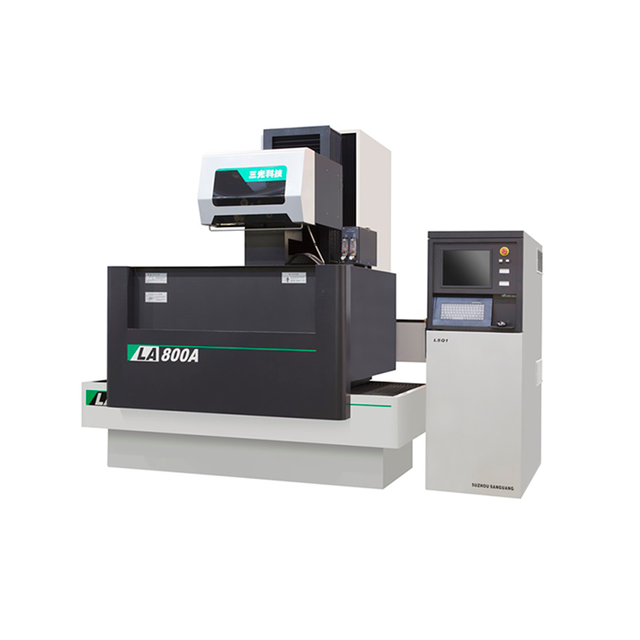
 HB400
HB400  HB600
HB600  HB800
HB800  LA350A
  LA500A
  LA800
LA800  EB450
EB450  EA500A
  EB650N
  DS703C
  SK450
SK450 


