
Machining workpieces taller than 6 inches introduces extreme fluid dynamic challenges into your shop. These harsh conditions drastically increase the risk of unexpected wire breakage during critical operations. Unpredictable breaks instantly destroy the viability of lights-out manufacturing and unattended machining runs. They generate costly scrap parts, frustrate operators, and skyrocket your overall machine downtime expenses. When a cut fails midway, recovering the part often feels impossible. This guide bypasses surface-level advice to examine the true metallurgical causes of wire failure in deep cavities. You will discover optimal parameter adjustments designed specifically to stabilize deep cuts. We also explore clear performance frameworks to help you evaluate when to upgrade from standard consumables to advanced coated alternatives.
Root Cause: Breakage in tall parts is rarely about low tensile strength; it is caused by poor flushing leading to secondary arcing and microscopic craters that exceed the wire's fracture toughness.
Parameter Priority: Increasing "off-time" and optimizing high-pressure flushing are the most critical first steps in stabilizing the cut.
Material Selection: Standard 63/37 brass wire struggles in deep cuts due to debris size; zinc-coated wires sublimate rather than melt, drastically improving flushing efficiency.
ROI Reality: While coated wires cost 1.5x to 2x more per spool, the resulting 20–30% speed increase and reduction in downtime often yield a net decrease in cost-per-part for tall workpieces.
Many operators assume wire snaps purely due to excessive physical tension. We need to completely dispel this myth. Wire breaks rarely happen just because of high mechanical pull. Electrical discharges constantly leave microscopic craters on the wire surface. Every single spark removes a tiny bit of material. When a single crater exceeds the wire’s critical flaw size, catastrophic fracture occurs. You can think of it as a microscopic stress concentration point. Once the crater grows too large, the remaining cross-section simply cannot handle the load. The wire fractures instantly.
Deep cuts amplify this metallurgical problem significantly. In parts taller than 6 inches, fluid dynamics change entirely. Tapers greater than 5 degrees also create similar issues. The hydrodynamic envelope of high-pressure flushing completely breaks down. Fresh dielectric fluid cannot easily reach the dead center of the cut. Flushing loses its critical velocity and pressure deep inside the kerf. This creates a dangerous, stagnant environment.
Trapped debris in the elongated spark gap acts as a conductive bridge. It actively prevents the gap from clearing properly between pulses. This trapped debris leads to concentrated, secondary high-energy arcing. Instead of cutting the workpiece, the spark attacks the wire itself. These secondary arcs create massive, fatal craters in the wire surface. Fracture toughness drops immediately to zero. The wire breaks, halting your lights-out operation entirely.
Adjusting your machine parameters provides the most effective immediate defense. You must give the dielectric fluid much more time to clear the gap. Extending the "off-time" is incredibly crucial here. A longer off-time allows the fluid to physically push debris out of the deep kerf. This single adjustment often stabilizes highly erratic cutting conditions. There is an unavoidable trade-off, however. Increased off-time naturally reduces your overall cutting speed. But a slightly slower, completely stable process always beats a fast process plagued by constant breaks.
Next, look closely at your voltage and feed rates. We highly recommend implementing adaptive control strategies. Modern EDM generators often support real-time gap monitoring. Rely on these smart systems to automatically reduce feed rates when they detect debris buildup. If your machine lacks this feature, manually lower your base feed rate for tall parts. Do not force the wire through dirty cuts.
Flushing pressure realities also demand your immediate attention. You must balance the upper and lower nozzle pressures perfectly. Uneven pressure directly causes the wire to deflect in the center of a tall workpiece. Industry veterans call this the "belly" effect. Bowed wire cuts inaccurately and breaks very easily under pressure.
Here are the critical step-by-step parameter checks:
Increase gap off-time by 10 to 20 percent above standard vendor recommendations.
Enable adaptive feed control systems to continuously monitor gap stability.
Equalize upper and lower flushing pressures carefully to prevent wire bowing.
Reduce your base cutting speed to accommodate the extended gap clearance time.
These steps drastically reduce sudden breakage events.
When standard Brass Wire EDM reaches its absolute limits, you must look at metallurgy. To understand effective debris removal, we introduce the concept of "heat of sublimation." This physical metric dictates exactly how a material behaves under intense heat. Standard bare brass wire simply melts and pools during a spark. When it cools in the fluid, it forms large, solid particles in the gap. These large particles are incredibly difficult to flush out of deep cavities. They clog the narrow kerf and cause constant secondary arcing.
Higher zinc content changes this dynamic entirely. Zinc sublimates at much lower temperatures than copper. It turns directly from a solid into a gas during the spark. This unique phase change creates microscopic particles rather than large solid chunks. These tiny particles easily flush away with minimal fluid pressure. They also act as a physical buffer against secondary arcing. This specific zinc advantage drastically improves cutting speed and flushing efficiency in deep cuts.
So, why not just make wire entirely out of zinc? Standard brass cannot exceed a roughly 40 percent zinc content limit. Beyond this precise threshold, the wire material becomes far too brittle. Manufacturers cannot draw it into a continuous thin wire. Spooling it around guides becomes physically impossible. Plain brass simply cannot carry enough zinc to optimize deep-cut flushing on its own.
Here is a quick summary chart of debris behavior:
Wire Material Type |
Reaction to Heat (Phase Change) |
Resulting Debris Particle Size |
Flushing Difficulty in Deep Cuts |
|---|---|---|---|
Standard Bare Brass |
Melts to Liquid State |
Large, Solid Chunks |
Very High (Clogs Kerf Easily) |
Zinc-Coated / Stratified |
Sublimates Directly to Gas |
Microscopic Fine Particles |
Very Low (Clears Instantly) |
Upgrading from bare brass to performance wires completely transforms deep-cut reliability. You essentially have two main solution categories to consider for shop upgrades. Type-A (Zinc-Coated) wire offers exceptionally high reliability for Auto Wire Threading (AWT) systems. It provides the best baseline defense for reducing random breaks. Type-D (Diffusion-Annealed or Stratified) wire handles extremely tall parts. It excels specifically in poor flushing conditions and offers significant roughing speed increases.
We need a solid economic framework to justify these premium consumables. Production managers often hesitate at the higher initial price tag. Let us look at a scalable ROI model for your shop floor. Suppose standard brass costs roughly $6 per pound. A high-performance coated alternative might cost $11 per pound. At first glance, the coated wire seems far too expensive for daily use.
Now look at a realistic calculation example. Imagine a deep-cut job takes 40 hours using standard brass. Coated wire can often reduce that exact job to 30 hours. You successfully save 10 hours of active machine time. If your standard machine hourly rate is $60 per hour, you save $600 in operational overhead. This massive overhead saving far exceeds the extra premium paid for the coated consumable.
Evaluating wire solely on "price per spool" remains a deeply flawed metric. It completely ignores the hidden costs of broken wire downtime. It also overlooks the massive expenses tied to AWT failures during lights-out shifts. You must always track the true cost-per-part to see the real manufacturing value.
Before hitting "Start" on a tall workpiece, you must verify your hardware alignment perfectly. Inspect your upper and lower power contacts closely. Look for deep grooving or excessive wear on these carbide surfaces. Worn contacts actively cause micro-arcing before the wire even enters the workpiece. This weakens the wire instantly and guarantees failure. You also need to ensure optimal wire tension calibration. Use a dedicated tension meter to confirm accuracy every week.
Next, program specific cutting strategies for maximum stability. We strongly recommend utilizing a step-cutting approach. This technique involves taking multiple lighter passes rather than one massive, aggressive cut. Step-cutting gradually relieves internal stress trapped in thick materials. You should also program dedicated skim cuts after roughing. Skim cuts gently remove residual stress left by the primary roughing pass. They successfully correct the "bowing" effect typical in tall part manufacturing.
Finally, perform strict fluid maintenance routines. Check your dielectric fluid conductivity daily. Ensure your filtration systems remain in excellent health. Dirty water severely exacerbates arcing in deep cuts. It provides an unwanted conductive path for rogue sparks. Clean fluid ensures perfectly stable cutting conditions and protects the delicate wire from premature failure.
Successfully machining tall workpieces requires actively moving away from default settings. You simply cannot rely on standard consumables for extreme depth applications. We highly recommend starting with immediate parameter adjustments on your current setup. Specifically, increase your gap off-time to physically clear debris more effectively. Slower, highly stable cutting strictly prevents costly scrap and operator frustration.
If stability requires slowing the machine down to totally unprofitable speeds, pivot your strategy immediately. It is definitely time to transition from standard brass wire to a stratified or coated alternative. Track your true machine-hour ROI to confidently justify the material upgrade. These calculated, data-driven changes will completely eliminate unexpected breaks and finally restore predictable, lights-out production capabilities.
A: Wire breakage in the middle of a tall cut results from fluid starvation and wire bowing. The high-pressure flushing loses its force deep inside the kerf. This traps debris in the center. The trapped debris causes secondary arcing, which rapidly damages the wire. Additionally, uneven flushing pressure pushes the wire into a curved "belly" shape, increasing mechanical stress.
A: No, you cannot use the exact same settings. You must adjust your generator settings to fully utilize coated wire. Coated wires withstand higher energies and require optimized pulse durations to achieve maximum speed. Running them on standard brass settings completely wastes their potential and may cause erratic cutting behavior.
A: Increasing wire tension does not prevent breakage in deep cuts. While proper tension maintains straightness, excessive tension actually lowers the wire's fracture limit. When microscopic craters form from electrical discharges, a highly tensioned wire snaps much faster. You should focus on improving flushing efficiency rather than increasing tension.
A: Standard brass wire generally handles workpieces up to 6 inches (150mm) efficiently. Beyond this height, fluid dynamics degrade, and debris removal becomes incredibly difficult. If you frequently cut parts taller than 6 inches, you should switch your methodology and invest in stratified or zinc-coated performance wires.
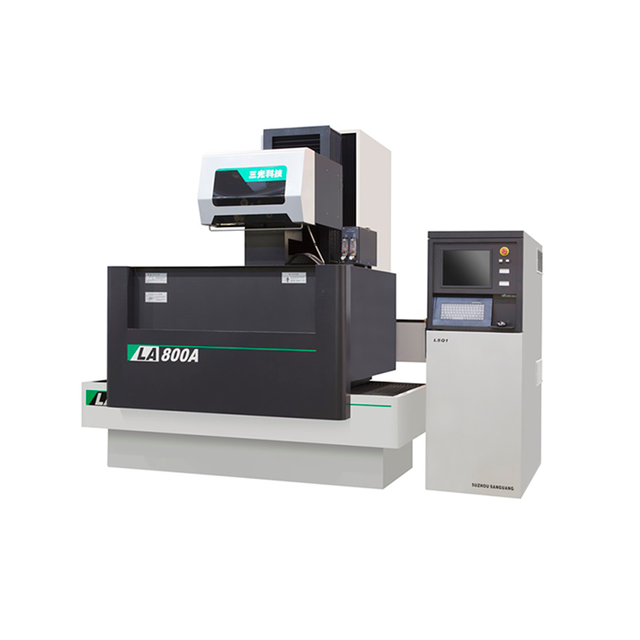

 HB400
HB400  HB600
HB600  HB800
HB800  LA350A
  LA500A
  LA800
LA800  EB450
EB450  EA500A
  EB650N
  DS703C
  SK450
SK450 


