
Procurement and production often face a frustrating tension on the shop floor. Standard brass wire is cheap to buy. However, cycle time remains the true bottleneck for profitability in electrical discharge machining.
You must evaluate high-zinc Brass Wire EDM, including zinc-coated and gamma-phase wires, as a calculated capacity multiplier. These advanced consumables are not mere luxury items. They serve as critical tools for high-volume or complex machining environments where standard wires fail to keep up with demanding production schedules.
This guide evaluates the operational advantages and implementation realities of upgrading your EDM wire. You will learn exactly how zinc dynamics improve cutting speed and part quality. We will also explore the practical trade-offs you must consider before switching to ensure your shop maintains seamless operations.
Cycle Time Reduction: High-zinc and gamma-phase wires consistently deliver 20% to 30% faster cutting speeds compared to standard 60/40 or 63/37 brass wire.
Flushing Efficiency: The low vaporization temperature of zinc creates larger spark craters and induces turbulent flow, significantly improving debris flushing in tall or restrictive workpieces.
Lower Cost-Per-Part: Despite higher upfront procurement costs, the reduction in machine hours typically yields a ~20% net decrease in total manufacturing cost per part.
Operational Trade-offs: The primary adoption risk is the potential for zinc powdering, which can impact Automatic Wire Threading (AWT) reliability and require adjusted maintenance schedules.
Zinc concentration completely changes how wire performs in the spark gap. Zinc features a significantly lower vaporization temperature than copper, vaporizing at roughly 907°C compared to copper's 2562°C. When the wire enters the active spark zone, the high-zinc outer layer vaporizes almost instantly. This rapid vaporization shields the structural copper core from immediate thermal degradation. It ensures the wire maintains its tensile strength while delivering maximum energy directly into the workpiece. Standard brass wires often suffer from core degradation because they lack this thick sacrificial outer layer.
Advanced high-zinc wires, such as Gamma-phase alloys, take this physical advantage further. During the specialized drawing and annealing process, these wires develop a micro-porous surface structure. You might mistakenly view this rough texture as a manufacturing defect. In reality, this textured surface acts as an aggressive fluid transport mechanism. It drags dielectric fluid into the exceptionally narrow spark gap. This physical action forces the fluid into a turbulent flow rather than a passive laminar flow. Turbulent flow radically improves the flushing of microscopic debris out of the cut zone, preventing secondary sparking.
Better thermal dissipation directly impacts your optimal machine settings. Higher zinc content absorbs the extreme heat of the continuous electrical discharge. Because the zinc layer sacrifices itself to protect the core, you can safely increase the pulse-on time. Pulse-on time serves as the primary driver for your Material Removal Rate (MRR) in any EDM process. You gain the ability to push more electrical power into the cut without risking immediate wire breakage. This dynamic fundamentally changes the speed limit of your existing machinery.
Engineers need hard, measurable data to justify changing daily consumables. Rigorous metallurgical testing constantly validates the performance gap between standard and coated wires. Research utilizing Taguchi method design of experiments proves this distinct difference. The Taguchi method isolates specific machining variables to find optimal configurations. These studies reveal that high-zinc coated wires achieve significantly higher Material Removal Rates (MRR) under identical machine settings compared to standard brass. By optimizing the pulse-on time and wire tension together, you can document a measurable speed increase of up to 30%.
To accurately validate these speed increases on your shop floor, follow these proven engineering steps:
Establish a Baseline: Record the exact machine hours and surface roughness (Ra) using your standard 63/37 brass wire on a complex test piece.
Optimize Pulse-On Time: Increase the discharge duration gradually when running the high-zinc alternative, carefully monitoring the spark stability indicator on your machine control.
Adjust Wire Feed Rate: Because the material removal rate increases, you may need to increase the wire speed slightly to ensure a fresh zinc layer is always present in the spark gap.
Measure Recast Layer: Use a microscope to inspect the cut cross-section, verifying the reduction in white layer thickness.
You will notice the most dramatic production improvements during inherently poor flushing conditions. Conventional brass wire struggles to clear metallic waste effectively in demanding scenarios. Excessively tall parts trap debris inside the deep cut zone, causing wire shorts and stalls. Steep taper cuts alter the nozzle stand-off distance, severely weakening the dielectric fluid pressure. High-zinc Brass Wire EDM utilizes its larger spark craters to literally blast debris out of these restrictive spaces. The aggressive vaporization creates microscopic pressure waves that push slag away from the active cutting zone.
Surface metallurgy also benefits heavily from this consumable upgrade. Improved discharge stability and superior debris flushing lead to a noticeably thinner recast layer. Machinists often call this the white layer. The white layer consists of re-solidified metal that becomes brittle and prone to micro-cracking. A uniform, minimal white layer reduces secondary thermal damage to the parent material. This becomes absolutely crucial when you cut hardened tool steels, aerospace titanium, or difficult tungsten carbide components.
Performance Metric | Standard Brass Wire (63/37) | High-Zinc Coated Wire |
|---|---|---|
Material Removal Rate (MRR) | Baseline speed limits | 20% to 30% faster cutting |
Debris Flushing Efficiency | Moderate (laminar flow) | Excellent (turbulent flow) |
Recast Layer Thickness | Thicker, prone to micro-cracks | Thinner, more uniform |
Pulse-On Time Tolerance | Low to Medium | High |
Spark Gap Stability | Fluctuates in deep cuts | Highly stable under poor flushing |
You must evaluate the real-world friction points of adopting new wire technology. Every shop faces specific operational trade-offs, and ignoring them will lead to unnecessary machine downtime. Implementing high-zinc wire requires proactive management of your equipment.
First, you must address Automatic Wire Threading (AWT) challenges. We must be completely transparent about AWT reliability when introducing new alloys. Some high-zinc or gamma-phase coatings are inherently brittle by design. The advanced coating can flake off as it forcefully passes through the tight threading mechanisms. This flaking potentially leaves fine powder residue behind in the guides. Over time, this zinc powder fouls AWT components, clogs pneumatic lines, and causes frustrating threading failures during unattended shifts.
Second, verify your generator compatibility. You cannot simply load a new spool of advanced wire and expect an automatic 30% speed increase. The EDM machine generator must be capable of delivering higher electrical power. Advanced wires require aggressive spark energy to perform optimally and vaporize the zinc layer effectively. Older legacy machines with limited generator output may only see marginal speed gains, making the upgrade less impactful for your specific shop.
Finally, switching to a zinc-rich consumable demands a heavily modified maintenance schedule. You will inevitably experience increased zinc build-up along the entire wire path. We strongly advise more frequent cleaning of wire guides, power contacts, and pinch rollers. You should clean the power feed contacts daily rather than weekly. Ignoring this basic maintenance leads to poor electrical contact, erratic cutting speeds, and premature wear on expensive machine components. These operational adjustments require your team to establish strict preventative cleaning routines before making the switch.
Choosing the right wire dictates your production success and overall equipment effectiveness. You cannot rely on a one-size-fits-all approach. Use this pragmatic framework for immediate decision-making on the shop floor.
You should stick to standard brass (60/40 or 63/37) if your operations match these criteria:
Unattended Lights-Out Manufacturing: You operate primarily in lights-out, unattended shifts over the weekend. In these setups, 100% AWT reliability remains your absolute highest priority. A single failed thread halts production until Monday morning.
Optimal Flushing Geometries: You machine simple, flat geometries with wide-open flushing conditions. Standard wire easily handles these basic tasks without requiring enhanced debris removal.
Cycle Time Independence: You cut low-margin parts where machine cycle time does not act as your operational bottleneck. If your EDM machines sit idle waiting for the milling department, faster wire will not improve your overall factory output.
Conversely, you should immediately upgrade to high-zinc or coated brass if your environment requires advanced capabilities:
Restrictive Cut Zones: You frequently machine excessively tall components. It also helps immensely when dealing with complex fixtures that force poor nozzle stand-off distances. The turbulent flushing action will prevent wire breakage in these deep cuts.
Capacity Constrained Facilities: You operate in a high-mix, high-volume environment where EDM time is heavily backlogged. In these shops, maximizing throughput directly dictates overall profitability. Shaving hours off a long roughing pass opens up capacity for new jobs.
Strict Metallurgy Requirements: You cut complex aerospace, medical, or defense components. These demanding industries require strict control over the final white layer and demand pristine surface integrity.
Upgrading to high-zinc Brass Wire EDM represents a strategic investment in your total machine capacity. By leveraging advanced metallurgy, you unlock significantly faster cycle times and superior part quality. You empower your existing machinery to operate safely beyond its standard speed limitations.
We highly recommend running a strictly controlled trial before committing to a facility-wide switch. Select a high-hour, benchmark part from your current production schedule. Run it first with standard wire to establish a baseline. Then, load the high-zinc wire. During the trial, you must carefully adjust your pulse-on time and wire feed parameters. You must tune the generator settings aggressively to accurately measure the true cycle-time reduction. Compare the final surface finish, the recast layer thickness, and the total machine hours against your historical data. This methodical engineering approach ensures your shop achieves the maximum possible performance gains without disrupting current deliveries.
A: Yes. Wire EDM relies entirely on thermal vaporization, not mechanical cutting force. High-zinc wire actually improves the stability of cuts in hardened materials. Its superior flushing capabilities ensure stable discharge, which significantly minimizes the recast layer on hard alloys.
A: Yes, slightly. The inherent brittleness of the zinc layer causes minor flaking during operation. This flaking leads to residue accumulation inside the machine. Operators must increase the cleaning frequency of guides and power contacts to maintain precision and prevent excessive wear.
A: No. The intense cutting process fundamentally alters the wire's physical and electrical properties. Sparking depletes the crucial zinc layer and induces severe thermal stress. Attempting to reuse it will guarantee frequent wire breakage, poor flushing, and a total loss of dimensional precision.

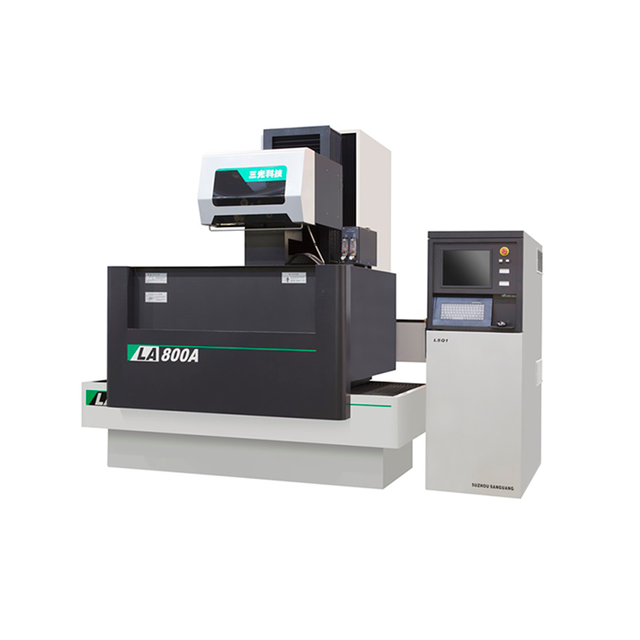
 HB400
HB400  HB600
HB600  HB800
HB800  LA350A
  LA500A
  LA800
LA800  EB450
EB450  EA500A
  EB650N
  DS703C
  SK450
SK450 


