
Views: 0 Author: Site Editor Publish Time: 2026-09-09 Origin: Site


Designing complex, high-precision cavities presents a hard physical limit in tooling and injection molding. Traditional cutting tools deflect, break, or simply cannot reach into tight clearances. When you mill hardened tool steels, the operational problems multiply rapidly. Tool wear destroys your margins. Secondary manual polishing introduces human error and alters cavity dimensions. You cannot machine a true sharp internal corner in a blind pocket with a rotating cylindrical endmill. This geometric reality compromises mold performance and part mating. You need a specialized approach to bypass these physical constraints.
The die sinking EDM machine handles these exact conditions. It does not replace your milling centers. It serves as a mandatory process for specific geometries, tight tolerances, and extreme material hardness in modern mold manufacturing. You must know exactly when to deploy this technology to maintain precision and control your shop floor workflow.
Geometry Dictates the Process: Die sinking EDM is mandatory for blind cavities with sharp internal corners, deep narrow ribs, and complex negative shapes where rotating cutting tools cannot reach.
Material Hardness is Irrelevant to Cutting Speed: Unlike traditional milling, spark erosion machines cut conductive materials regardless of their Rockwell hardness, making them ideal for pre-hardened tool steels, tungsten carbide, and exotic alloys.
Electrode Strategy is the True Cost Driver: The ROI of a die sinker EDM operation hinges heavily on the cost, machining, and wear-management of custom graphite or copper electrodes.
Unmatched Repeatability for Multi-Cavity Molds: CNC die sinking EDM ensures exact replication of the electrode geometry across multiple cavities, guaranteeing identical molded parts.
Surface Finish Capabilities: Advanced CNC die sinking EDM can achieve near-mirror surface finishes (low Ra values), often eliminating the need for manual benching and polishing in mold cavity machining.
The physics behind a plunge EDM process rely on controlled electrical discharges. The machine utilizes a custom-machined electrode acting as the cathode, while the workpiece acts as the anode. Both components sit submerged in a dielectric fluid. The machine applies a rapid series of voltage pulses between the electrode and the workpiece. The dielectric fluid acts as an insulator until the voltage potential exceeds its dielectric strength. At this exact moment, the fluid ionizes, creating a microscopic plasma channel. The resulting spark generates localized temperatures between 8,000 and 12,000 degrees Celsius. This instantly melts and vaporizes a tiny volume of the workpiece material. The dielectric fluid then collapses the plasma channel and flushes the microscopic debris away. This cycle repeats thousands of times per second, gradually eroding the exact negative shape of the electrode into the steel.
You cannot achieve an accurate burn without proper flushing. The dielectric fluid serves three distinct purposes: it insulates the gap, cools the electrode and workpiece, and flushes away the eroded metal particles (swarf). If swarf accumulates in the spark gap, it causes secondary arcing. Secondary arcing pits the cavity walls and destroys the surface finish. Machinists use several flushing techniques to prevent this. Pressure flushing forces fluid down through a pre-drilled hole in the electrode. Suction flushing pulls fluid down through the workpiece. External nozzle flushing directs high-velocity streams directly at the spark gap. Selecting the right hydrocarbon oil or synthetic dielectric fluid also impacts performance. Synthetic fluids offer higher flash points and better oxidation resistance, keeping the machine cleaner during heavy roughing cycles.
You must define what constitutes a successful operation in mold cavity machining. Success is not merely about material removal. A successful cavity burn requires dimensional accuracy held within two to three microns. It demands a uniform surface finish across complex 3D topographies. The process must yield zero heat-affected zone (HAZ) distortion, ensuring the metallurgical integrity of the mold block remains intact. The ultimate goal is the exact, predictable replication of the electrode geometry into the steel without inducing mechanical stress.
Modern CNC die sinking EDM systems transform a manual erosion process into a highly automated, predictable workflow. The CNC controller dynamically manages the spark gap, which is the physical distance between the electrode and the workpiece. If the gap becomes too small, the controller instantly retracts the Z-axis to prevent a short circuit. CNC integration also enables complex orbital movements. Instead of a simple straight plunge, the machine moves the electrode in circular, square, or spherical patterns. Vector orbiting allows the machine to move in X, Y, and Z simultaneously. This orbital capability allows operators to use a single electrode for both roughing and finishing passes simply by expanding the orbit radius and reducing the spark energy.
Scaling production requires absolute consistency. When manufacturing a 16-cavity or 32-cavity injection mold, variance between cavities leads to rejected plastic parts. Traditional milling introduces tool wear, meaning the first cavity cut will have slightly different dimensions than the last cavity cut. A die sinking EDM eliminates this variable. By utilizing a standardized set of roughing and finishing electrodes, engineers burn identical features across an entire mold plate. The non-contact nature of the process ensures zero tool-deflection variance, guaranteeing that cavity number one is a perfect clone of cavity number thirty-two.
Traditional CNC milling relies on physical contact and shearing forces. When machining deep cavities, operators must use long, thin endmills. These tools act as cantilever beams. As the cutting edge engages the material, mechanical forces push the tool away from the cut. This phenomenon, known as tool deflection, leaves excess stock on the cavity walls and induces chatter. When the aspect ratio (length to diameter) of an endmill exceeds 5:1, deflection becomes a severe limitation. A die sinker EDM exerts absolutely zero mechanical cutting force on the workpiece. The electrode never touches the steel. You can machine extremely deep, narrow features without any risk of deflection, chatter, or tool breakage.
Geometry often dictates the manufacturing method. It is physically impossible to machine a perfectly sharp 90-degree internal corner with a cylindrical rotating tool. An endmill will always leave an internal radius equal to the radius of the tool itself. While engineers can use smaller endmills to reduce the radius, they can never eliminate it entirely. Many mold designs require perfectly sharp internal corners to accommodate mating inserts or specific part features. Plunge EDM solves this geometric impossibility. Because the electrode is shaped externally, you can mill a sharp external corner on a graphite block with ease. That sharp external corner then burns a perfectly sharp internal corner into the mold cavity.
Machining hardened materials exposes the harsh economic limits of traditional milling. When vertical machining centers (VMCs) attempt to mill tool steels hardened above 50 HRC, consumable tooling costs increase exponentially. Carbide inserts chip, spindle loads spike, and machine time balloons due to required slow feed rates. The erosion rates of an EDM process remain entirely unaffected by material hardness. The spark vaporizes the metal regardless of its heat treatment. This predictable erosion rate allows engineers to accurately forecast machining times and costs without worrying about sudden tool failures ruining a nearly completed mold block.
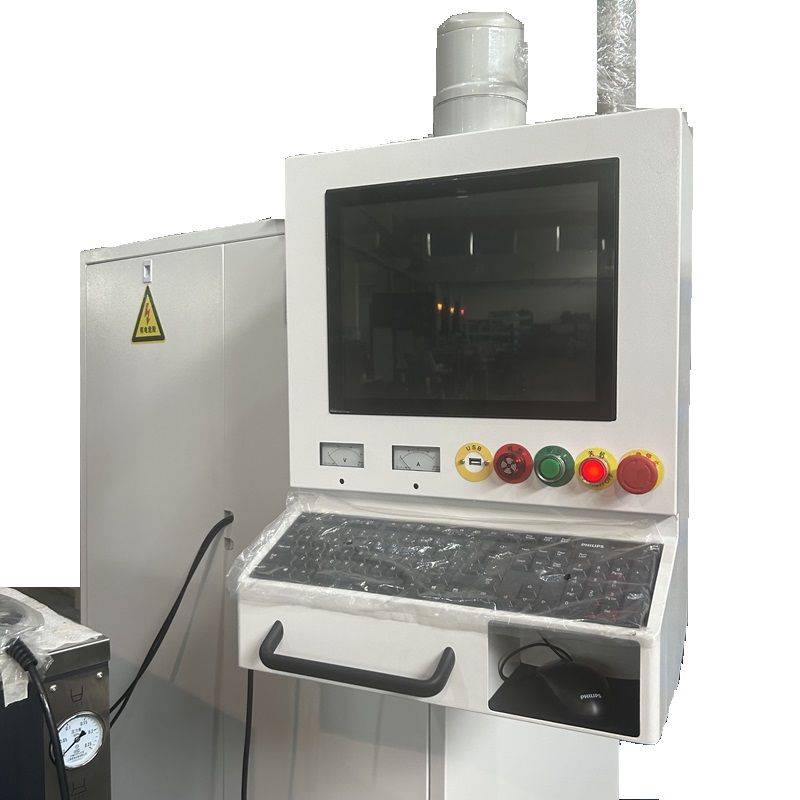
Thermal distortion ruins tight-tolerance molds. If you machine a soft block of steel and then send it to heat treatment, the material will warp, shrink, or expand unpredictably. To eliminate this risk, engineers heat-treat the mold block first, bringing it to its final hardness before machining the complex cavities. A spark erosion machine handles pre-hardened H-13, S-7, or D-2 tool steels effortlessly. It is the only viable method for machining ultra-hard tooling materials like tungsten carbide or aerospace-grade superalloys, which immediately destroy conventional cutting tools. When burning tungsten carbide, operators must use specific generator settings with negative polarity to prevent the depletion of the cobalt binder.
Plastic injection molds frequently require deep structural ribs to reinforce the final plastic part. These ribs often demand cavities that are merely millimeters wide but tens of millimeters deep. Attempting to mill these features requires microscopic endmills that snap under minimal lateral loads. Engineers utilize thin graphite electrodes to burn these deep, narrow ribs. Graphite maintains structural rigidity even at very thin cross-sections, allowing the EDM process to plunge deep into the mold block without structural failure.
Surface finish directly impacts the ejection of the plastic part and its final aesthetic appearance. Traditional milling leaves distinct tool marks and scallops that require hours of manual benching and polishing. Spark erosion can be meticulously tuned by adjusting the amperage and pulse duration to leave a specific, uniform surface finish. This finish is often measured on the VDI scale. The EDM process leaves a consistent, multi-directional matte texture across complex 3D contours. This texture transfers directly to the molded plastic part, eliminating the need for secondary polishing operations entirely.
Many mechanical components require blind pockets shaped like hexes, splines, stars, or asymmetrical gears. You cannot broach a blind hole because the broaching tool needs an exit path. You cannot mill a sharp internal spline with a round tool. Die sinking EDM provides the only reliable solution. You simply machine the electrode into the shape of the required hex or spline and plunge it directly into the solid workpiece. The machine burns the exact negative geometry, regardless of its complexity.
Certain mold components feature delicate, thin-walled sections that cannot withstand the clamping forces or shearing pressures of traditional machining. A VMC will easily crush, bend, or tear these fragile features during the cutting cycle. Because the EDM process relies on electrical discharges across a microscopic fluid gap, there is no physical contact. The lack of mechanical cutting force prevents the deformation of delicate workpiece features, allowing engineers to machine incredibly fragile geometries safely.
You must understand the fundamental distinction between these two spark erosion technologies. Wire EDM functions like a highly precise, electrically charged bandsaw. It uses a continuous spool of wire to cut completely through a workpiece. It is strictly limited to through-holes, 2D profiles, and 4-axis ruled surfaces. You cannot use a wire EDM to cut a blind pocket. Conversely, a die sinking EDM acts like a 3D stamp. It plunges a pre-shaped solid electrode into the material, making it the absolute requirement for blind cavities, complex 3D topographies, and bottom-stopping features.
The tooling logistics differ drastically between the two methods. Wire EDM utilizes a continuous spool of inexpensive brass or zinc-coated wire. The machine constantly feeds fresh wire into the cut, meaning custom tooling costs are virtually zero. Die sinking EDM requires a completely different workflow. You must design, program, and CNC mill custom copper or graphite electrodes for every unique cavity shape. This requirement makes the front-end tooling cost for plunge EDM significantly higher, demanding careful planning and electrode management.
Complex mold projects frequently require both technologies working in sequence. Consider a mold designed to produce a complex plastic gear. Engineers will typically use a Wire EDM machine to cut the highly accurate, through-hole profile of the mold core. The wire provides unmatched precision for the external gear teeth. Subsequently, they will mount a custom electrode into a plunge EDM machine to burn the corresponding blind cavity into the mating mold plate. Utilizing both machines leverages the specific geometric strengths of each process.
The hidden bottleneck in any die sinking operation is electrode manufacturing. The EDM machine can only be as accurate as the electrode it uses. Engineers must constantly evaluate the trade-offs between different electrode materials based on the specific cavity requirements.
Electrode Material |
Machinability |
Wear Resistance |
Surface Finish Quality |
Primary Application |
|---|---|---|---|---|
Graphite (Ultrafine Grain) |
Extremely fast to mill; low cutting forces. |
Excellent in roughing; resists thermal shock. |
Good, but leaves a slightly rougher matte texture. |
High-volume material removal; large cavities; deep ribs. |
Copper |
Slower to mill; prone to burr formation. |
Higher wear in roughing; excellent corner retention. |
Superior; capable of near-mirror finishes. |
Fine detailing; finishing passes; aerospace alloys. |
Copper-Tungsten |
Difficult to machine; high tool wear on VMC. |
Exceptional wear resistance; holds sharpest corners. |
Excellent; highly uniform. |
Burning tungsten carbide; ultra-precision aerospace parts. |
Graphite is highly abrasive and requires specialized dust collection systems on the VMC used to mill it. It machines rapidly and maintains excellent dimensional stability. Copper provides superior surface finishes and holds ultra-fine details without chipping, but it takes significantly longer to machine and requires meticulous deburring. Copper-tungsten offers the best wear resistance but demands rigid milling setups to manufacture the electrode.
Estimating costs requires comparing the entire workflow, not just the time spent cutting steel. A common industry challenge is accurately forecasting EDM costs versus hard milling costs. You must utilize a comprehensive framework.
Calculate Electrode Material Cost based on the required block size.
Add Electrode CNC Milling Time and Electrode Inspection Time.
Factor in EDM Setup Time, including tramming and indicating the electrode.
Calculate EDM Burn Time based on the required amperage and material removal rate.
Compare this total against VMC hard milling: VMC Hard Milling Time + Consumable Carbide Tooling Costs + Machine Downtime for Tool Changes + Manual Benching and Polishing Time. While the raw volumetric material removal rate of a VMC is faster, the EDM process often wins the cost analysis on hardened steels because it entirely eliminates consumable carbide costs and drastically reduces manual polishing labor.
Deploying this technology requires strict environmental and operational controls. Failure to manage these variables results in scrapped mold blocks.
Electrode Wear and Overburn: The spark erosion process degrades the electrode. The resulting cavity will always be slightly larger than the electrode due to the spark gap (overburn). Engineers must calculate this overburn precisely and program the VMC to mill the electrode undersized. They must utilize a multi-electrode strategy, using one electrode to rough out the bulk material and a fresh, pristine electrode to finish the cavity to exact tolerances.
Dielectric Fluid Management: The dielectric fluid acts as both an insulator and a flushing agent. As it fills with microscopic metal particles, its dielectric strength changes, leading to unstable cutting conditions. Facilities must implement rigorous fluid management, utilizing high-performance filtration systems to remove particles down to 1-2 microns. Chilling systems are required to maintain fluid viscosity and temperature during aggressive roughing cycles.
Thermal Stability: Precision machining demands thermal control. Long burn cycles generate significant heat. If the ambient temperature of the facility fluctuates, the machine components and the workpiece will experience thermal expansion and contraction. This movement destroys micron-level tolerances. Operating these machines necessitates a strict, climate-controlled environment to ensure absolute thermal stability throughout the duration of the burn.
Audit your current mold designs to identify blind pockets and sharp internal corners that cause excessive endmill wear or require secondary broaching.
Calculate your monthly consumable carbide tooling expenses on materials exceeding 50 HRC to establish a baseline for EDM cost comparison.
Run a direct time-study comparing your manual benching and polishing hours against the automated VDI surface finish capabilities of a spark erosion process.
Evaluate your internal milling capacity to determine if you can manufacture graphite electrodes in-house or if you need to outsource electrode production.
Consult with an application engineer to determine the exact dielectric fluid filtration and thermal control requirements for your specific facility layout.
A: There is no functional difference. Plunge EDM, ram EDM, cavity EDM, and die sinker EDM are all synonymous industry terms. They all refer to the exact same spark erosion technology that utilizes a shaped electrode plunging into a workpiece to create blind cavities and complex 3D shapes.
A: Modern CNC systems are exceptionally accurate. Depending on the specific machine condition, electrode quality, and environmental thermal controls, standard tolerance capabilities typically hold within +/- 0.0001 inches, or roughly 2 to 3 microns.
A: No. The fundamental requirement of the spark erosion process is electrical conductivity. The voltage must pass between the electrode and the workpiece. Therefore, it cannot cut plastics, ceramics, or wood. It is highly effective on conductive materials like titanium, tungsten carbide, and hardened tool steels.
A: The electrical discharges that erode the steel also slowly erode the electrode. This wear alters the electrode's geometry, particularly on sharp corners. To maintain exact cavity dimensions, operators must account for this degradation by using multiple electrodes—one for roughing and a fresh one for final finishing.
A: In terms of raw volumetric material removal rates, yes, it is slower. However, when machining hardened steels, it is often faster and more cost-effective overall. It eliminates the need for secondary heat treatments, avoids costly tool breakage, and drastically reduces manual polishing time.
A: Advanced machines equipped with fine-finishing generators can achieve sub-micron Ra surface finishes. By reducing the spark energy and utilizing orbital routines, the machine can produce near-mirror finishes, significantly reducing or entirely eliminating the need for manual benching.
 HB400
HB400  HB600
HB600  HB800
HB800  LA350A
  LA500A
  LA800
LA800  EB450
EB450  EA500A
  EB650N
  DS703C
  SK450
SK450 


