


Die Sinking EDM (Electrical Discharge Machining) is a game-changer in modern manufacturing. This process uses electrical discharges to precisely erode material, creating intricate shapes with remarkable accuracy.
In this article, we'll dive into how Die Sinking EDM works, its key components, and why it's essential for industries demanding high precision.You'll learn how this technique benefits industries like aerospace, automotive, and medical manufacturing, and discover its applications in producing complex components.
Die Sinking EDM is a machining process where electrical discharges are used to erode material from a workpiece, creating intricate and precise cavities or shapes. The technique uses a shaped electrode, often made from materials like copper or graphite, which is submerged in a dielectric fluid. When a voltage is applied, sparks jump across the gap between the electrode and the workpiece, eroding the material and forming the desired shape.
This method is especially effective for crafting complex shapes in hard materials that would be difficult to achieve through traditional machining methods. It’s widely used in mold making and tooling, offering the ability to create both shallow and deep cavities with exceptional precision.
The Die Sinking EDM process relies on controlled electrical discharges to erode a workpiece. Here’s how it works:
1. Electrode Selection: A shaped electrode, which matches the negative of the desired cavity, is used.
2. Dielectric Fluid: The electrode and workpiece are submerged in a dielectric fluid, which serves to insulate and cool the process.
3. Spark Erosion: High-voltage sparks are discharged between the electrode and the workpiece, creating intense heat that melts and vaporizes small portions of the material.
4. Material Removal: The material is gradually eroded, leaving behind a cavity or shape that mirrors the electrode.
The process is highly controlled, and the gap between the electrode and the workpiece is carefully managed by a servomechanism to ensure precision.
Die Sinking EDM offers several advantages over traditional machining methods. These include:
● Complex Shapes: EDM can easily create intricate and complex designs that would be impossible with traditional cutting tools.
● Precision: The ability to create shapes with very tight tolerances, making it ideal for high-precision components.
● Excellent Surface Finish: Unlike conventional machining, EDM often provides a smooth finish, reducing or eliminating the need for post-processing.
However, it is particularly effective when working with hard materials like steel, which may be difficult to machine using other methods.
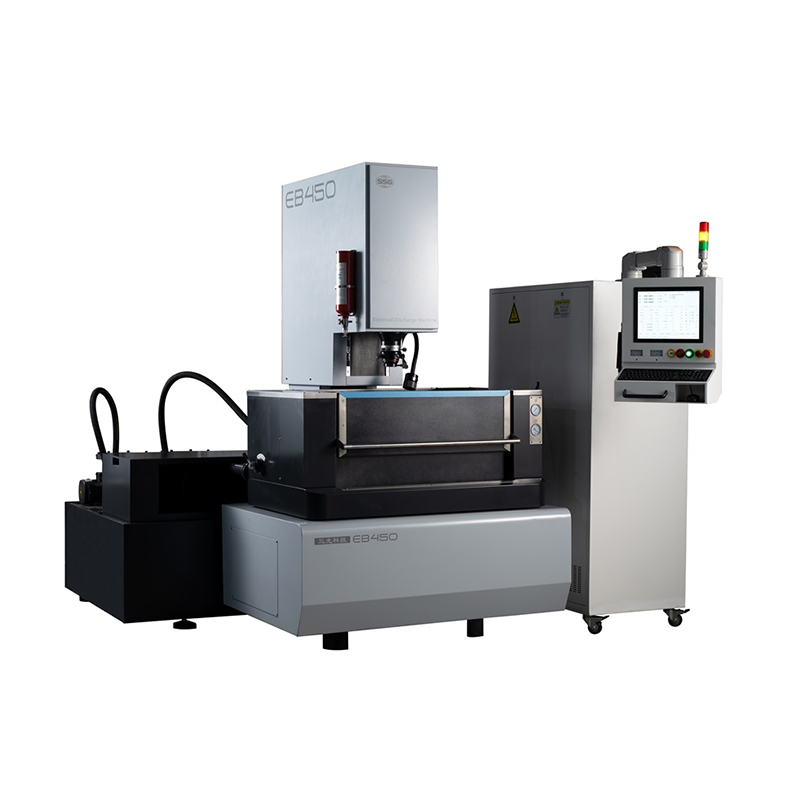
Electrode materials play a significant role in the efficiency and effectiveness of the Die Sinking EDM process. Common materials for electrodes include:
Material | Advantages | Disadvantages |
Graphite | Excellent wear resistance, thermal stability, cost-effective | Less conductive than copper, can wear faster in some cases |
Copper | High conductivity, good wear resistance | Harder to machine than graphite |
Brass | Easy to machine, good for smaller precision electrodes | Less durable than copper or graphite |
The electrode material must be chosen based on factors such as heat resistance, wear resistance, and the desired precision of the final product.
Dielectric fluid plays a critical role in the EDM process. It acts as an insulator, allowing the spark to discharge without damaging the components. Additionally, it cools the system and flushes away eroded material. Common dielectric fluids include:
Dielectric Fluid | Advantages | Disadvantages |
Hydrocarbon Oils | Good insulation, heat dissipation, widely used | May not provide the finest finish compared to water |
Deionized Water | Provides finer finishes, reduces contamination | Less commonly used than oil, more sensitive to impurities |
Kerosene | Higher flash point, safer for certain applications | May not be as effective for finer finishes as water or oil |
The cleanliness and temperature of the dielectric fluid are crucial for maintaining consistent results.
The power supply in a Die Sinking EDM machine provides the high-frequency pulse that creates the sparks. It must be capable of adjusting the pulse frequency and duration for optimal machining conditions. The servomechanism ensures that the electrode maintains a consistent gap from the workpiece, adjusting automatically as material is eroded, allowing for high-precision machining.
Die Sinking EDM is particularly effective in the production of molds and dies. The ability to create detailed cavities and intricate shapes makes it ideal for industries like:
● Injection Molding: Creating molds for plastic parts.
● Die-Casting: Producing molds for metals like aluminum and zinc.
● Forging: Making tools and molds for shaping metals.
This process enables manufacturers to create molds with complex geometries that would be challenging using traditional methods.
Die Sinking EDM is widely used in aerospace and medical device manufacturing, where precision is paramount. It can produce parts with extremely tight tolerances, such as:
● Aerospace: Components like turbine blades and heat exchangers that require precise detailing.
● Medical: Surgical instruments and implants that need to meet strict accuracy standards.
The ability to work with tough materials like titanium or high-alloy steel makes it indispensable for these industries.
Die Sinking EDM is also crucial in the automotive and electronics sectors, where complex parts and tight tolerances are required. Some examples include:
● Automotive: Precision parts such as gears, valves, and sensors.
● Electronics: Creating molds for microelectronic components and circuit boards.
By using Die Sinking EDM, manufacturers can ensure that their components meet the highest standards for quality and precision.
Industry | Applications |
Mold and Die Manufacturing | Injection molding, Die-casting, Forging |
Aerospace & Medical | Turbine blades, Heat exchangers, Surgical tools |
Automotive & Electronics | Gears, Valves, Sensors, Microelectronic components |
● Complex Shapes: Ideal for creating intricate designs and deep cavities that are hard to achieve with traditional methods.
● Precision: Offers exceptional precision, making it ideal for high-tolerance applications.
● Non-Contact Process: Since there is no physical contact between the electrode and the workpiece, it minimizes tool wear and mechanical stress.
● Slower for Simple Cuts: For simple or shallow cuts, Die Sinking EDM is slower than other methods like wire EDM.
● Higher Costs: The need for custom electrodes and the complexity of the setup can make the process more expensive.
● Material Limitations: Only works with conductive materials, meaning it cannot be used on non-metals or some ceramics.
Advantages | Limitations |
Complex shapes and deep cavities | Slower for simple cuts |
Exceptional precision | Higher operational costs |
Non-contact process | Limited to conductive materials only |
CNC Die Sinking EDM machines offer significant advantages in precision and automation. With multi-axis control, these machines can create highly complex molds and parts with automated programming, reducing human error and production time.
ZNC (Z-axis control) machines are designed for more basic operations where less automation is needed. While they offer precision, they are generally less advanced than CNC machines. ZNC machines are commonly used for simpler dies and molds.
Machine Type | Features | Ideal Use |
CNC Die Sinking EDM | High precision, multi-axis control, automated programming | Complex molds and parts, high precision |
ZNC Die Sinking EDM | Z-axis control, basic operations, less automation | Simpler dies and molds |
The most common electrode materials used in Die Sinking EDM are graphite, copper, and brass. Each material offers its own advantages in terms of conductivity, wear resistance, and ease of machining.
Die Sinking EDM is used for a wide range of materials, including:
● Metals: Steel, titanium, and copper.
● Ceramics: Harder ceramics that are difficult to machine using conventional methods.
● Alloys: Including tungsten and molybdenum for highly demanding applications.
With advancements in automation and artificial intelligence, Die Sinking EDM machines are becoming more efficient. Predictive maintenance, process optimization, and real-time monitoring will continue to improve the overall performance of EDM operations.
New materials and coatings will enable Die Sinking EDM to be used in a wider range of applications. As industries demand more complex, high-performance components, Die Sinking EDM will remain at the forefront of precision manufacturing.
Die Sinking EDM is essential for industries requiring high precision and complex designs. It excels in creating intricate shapes and fine details, making it crucial for mold making, aerospace, and medical device manufacturing. As technology evolves, Die Sinking EDM continues to expand, driving innovation in high-precision manufacturing. Companies like Suzhou Sanguang Science & Technology Co., Ltd. provide advanced Die Sinking EDM products, offering exceptional value with their precision and efficiency in creating complex components.
A: Die Sinking EDM is a machining process that uses electrical discharges to precisely erode material and create intricate shapes. It is commonly used in mold making, aerospace, and medical device manufacturing.
A: Die Sinking EDM works by using an electrode that generates electrical sparks, eroding the workpiece submerged in dielectric fluid. This process creates cavities or intricate shapes with high precision.
A: Die Sinking EDM is ideal for mold making because it can create detailed and complex shapes that are difficult to achieve with traditional machining methods.
A: The main advantages of Die Sinking EDM include its ability to produce complex shapes, high precision, excellent surface finishes, and minimal wear on tools.
A: The cost of Die Sinking EDM varies depending on the complexity of the job, material type, and machine used. However, it tends to be more expensive than traditional machining due to its precision and the need for custom electrodes.
 HB400
HB400  HB600
HB600  HB800
HB800  LA350A
  LA500A
  LA800
LA800  EB450
EB450  EA500A
  EB650N
  DS703C
  SK450
SK450 


