


Electrical Discharge Machining (EDM) plays a key role in precision manufacturing, especially for hard metals. One question often asked is whether EDM uses AC or DC. Understanding this distinction is crucial for optimizing machining processes.
In this article, we will delve into the power supplies used in EDM, focusing on Die Sinking EDM and the roles of AC and DC in the process.

Electrical Discharge Machining (EDM) is a non-traditional machining process that uses controlled electric discharges to erode material from a workpiece. Unlike traditional machining methods that rely on mechanical cutting, EDM uses an electrical discharge between a tool (electrode) and a conductive material. These discharges are powerful enough to melt and vaporize the material at the point of contact, allowing for precise cuts even in very hard materials.
The process is especially valuable for shaping complex geometries, such as intricate cavities, fine holes, or delicate contours, in metals that are difficult to machine with conventional methods.
Power supply plays a critical role in the EDM process, directly influencing the quality and efficiency of material removal. In EDM, the power supply generates the electrical discharges that remove material from the workpiece. To achieve consistent and precise material removal, the spark gap must be stable, and the discharge must be carefully controlled. This is where the type of current—AC or DC—becomes important. Both types have specific advantages in different EDM applications.
In most EDM machines, direct current (DC) is used for the power supply. DC is preferred for its ability to provide stable, consistent sparks that result in efficient material removal. The setup for DC EDM is simple: the workpiece is usually connected to the positive terminal, while the tool electrode is connected to the negative terminal.
The advantages of DC power in EDM include:
● Stable spark generation: The consistency of DC power allows for controlled erosion, leading to higher precision.
● Efficient material removal: DC power ensures that the material is eroded consistently, reducing the chances of undesirable surface effects.
For many materials, especially hard metals, DC is the go-to power source because it leads to faster, more efficient machining.
Although DC is the primary power supply used in EDM, alternating current (AC) power or Anti-Electrolysis (AE) power supplies are sometimes used, particularly when machining certain materials. AC power can reduce some of the unwanted side effects that DC power might cause, such as material discoloration or cobalt depletion.
AC power is commonly used for:
● Improved surface finish: When machining materials like titanium or carbide, AC power helps reduce the formation of blue oxide layers or cobalt binder depletion, which are common issues with DC.
● Reducing electrolysis effects: AC can reduce the buildup of electrolysis, which can cause surface imperfections on certain materials.
In applications where surface finish and material preservation are critical, AC power is preferred over DC.
While both AC and DC are used in EDM, they serve different purposes based on the material and the desired outcome. The key differences are:
Aspect | DC Power | AC Power |
Material Removal Efficiency | Better for faster, more efficient material erosion, ideal for hard, conductive materials. | Slower material removal compared to DC. |
Surface Finish | Often leaves oxidation layers on the surface, suited for materials where removal efficiency is prioritized. | Used when surface finish is critical, helps minimize oxidation and preserve material integrity. |
Electrode Wear | Tends to cause faster electrode wear due to higher energy discharges. | Helps extend electrode life by reducing unwanted layer buildup on the workpiece. |
Many EDM machines use an AC power supply, but the current is typically converted to DC before it is used in the machining process. This conversion is accomplished using a rectifier, which changes the incoming AC to pulsating DC. The rectified DC is then used to generate controlled, rapid electrical discharges that erode material from the workpiece.
The conversion of AC to DC ensures that the EDM process is efficient and precise. The rectifier helps smooth out the flow of current, providing a stable and consistent power source for the discharges.
While continuous DC is often used in EDM, pulsed DC is increasingly being employed for better control over the discharge process. In pulsed DC EDM, the power supply generates rapid, controlled pulses of DC power rather than a steady flow of current.
This pulsed method provides several benefits:
● Enhanced precision: Pulses allow for more precise control over the amount of material removed.
● Reduced wear on electrodes: Pulsed DC minimizes the wear on the electrode, as the discharge occurs in short bursts rather than a continuous flow.
● Improved surface finish: Pulsed discharges allow for a finer and smoother surface finish, reducing the need for post-machining polishing.
Benefit | Pulsed DC Power |
Precision | More precise control over material removal. |
Electrode Wear | Reduced wear due to short bursts of discharge. |
Surface Finish | Finer, smoother finish with less need for polishing. |
DC power is known for its stable spark gap, which is crucial for the consistency and efficiency of material removal in EDM. The positive workpiece and negative electrode setup ensures that the discharges occur in a controlled and repeatable manner, providing reliable and predictable results. This stability is particularly important in high-precision applications where even slight variations in the spark can affect the outcome.
DC-powered EDM machines typically offer a higher energy efficiency compared to their AC-powered counterparts. The consistent nature of DC discharges ensures that the material removal process is faster and more efficient, which translates into reduced machining time and less waste. For manufacturers looking to optimize production times, DC power is often the preferred choice.
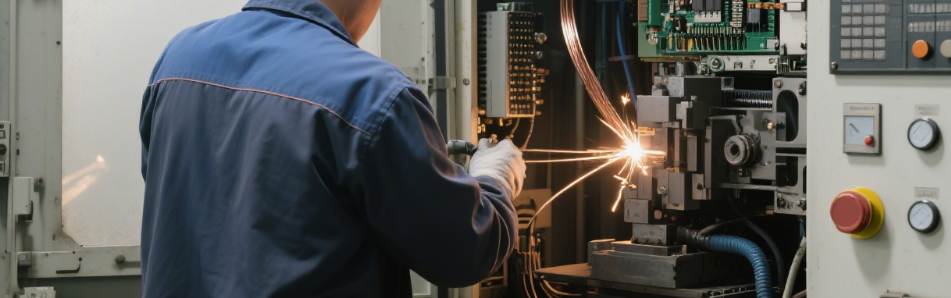
While DC is generally more efficient for material removal, AC power or Anti-Electrolysis (AE) power supplies are sometimes used for specific materials or applications. These are particularly useful when machining metals that are prone to oxidation or surface discoloration, such as titanium, carbide, and cobalt.
For example, when machining titanium, DC power can leave a blue oxide layer on the surface, while AC power can prevent this by minimizing electrolysis effects. Similarly, in carbide machining, DC can lead to cobalt depletion, which can affect the tool's longevity, whereas AC helps preserve the material's integrity.
AE or AC power supplies are often chosen when a high-quality surface finish is required. These power supplies reduce surface imperfections and provide smoother, cleaner cuts. This is especially beneficial in industries such as aerospace and medical device manufacturing, where precision and finish quality are paramount.
While DC power is the preferred option for many EDM applications, it may not always provide the best results. DC is less effective when machining materials that are particularly sensitive to electrolysis or oxidation. For instance, titanium and certain alloys may experience surface discoloration or degradation when processed with DC power.
In cases where surface finish is a top priority or when machining materials that are prone to electrolysis, AC power may be the better choice. AC provides a smoother, more even finish and helps preserve the material's integrity, making it ideal for delicate or high-performance materials.
Material Type | Recommended Power Supply |
Titanium | AC Power (to reduce oxidation and preserve material integrity) |
Carbide | AC Power (to prevent cobalt depletion) |
Aluminum | DC Power (for efficient material removal) |
Steel (Hard Metals) | DC Power (for faster material erosion) |
Copper | DC Power (for stable material removal) |
Precious Metals | AC Power (to improve surface finish) |
In conclusion, EDM mainly uses DC power for efficient and consistent material removal. However, AC or Anti-Electrolysis (AE) power is beneficial for certain materials, improving surface finish and material preservation. Understanding the difference between AC and DC helps manufacturers optimize their processes. For the best results, consider the material and surface finish required. Suzhou Sanguang Science & Technology Co., Ltd. offers advanced EDM solutions, ensuring precision and efficiency for various applications.
A: Die Sinking EDM primarily uses DC power for efficient material removal, providing stable spark generation and better control over the process.
A: DC power offers higher material removal efficiency and stable spark discharge, making it ideal for hard, conductive materials in Die Sinking EDM.
A: AC power is used in EDM when surface finish is critical, as it helps minimize oxidation and improves material preservation, especially for materials like titanium.
A: DC provides faster material removal and more control, while AC is better for surface finish and minimizing oxidation, especially in Die Sinking EDM.
A: Yes, Die Sinking EDM with pulsed DC power can achieve a fine, smooth surface finish, reducing the need for additional polishing.
 HB400
HB400  HB600
HB600  HB800
HB800  LA350A
  LA500A
  LA800
LA800  EB450
EB450  EA500A
  EB650N
  DS703C
  SK450
SK450 


